Quick Answer
Getting started with advanced AI automation requires a proper deployment foundation. Whether you are aiming to perform a smooth hermes agent installation on a dedicated Linux machine, set up a local testing environment via WSL, or evaluate containerized deployment options, getting the initial configuration right is essential. This guide walks you through every step of the process, from verifying dependencies to running your first test query and troubleshooting common environment-specific errors.
Quick Answer: Installing and Running Hermes Agent
For developers who want the fast path to getting up and running, the core process involves four straightforward phases: installing documented system prerequisites, executing the official package installation command, configuring your chosen model provider API keys, and validating functionality with a quick verification check.
To quickly execute a hermes agent install on a compatible Unix-like system, ensure Python is updated, fetch the package via your preferred package manager, set your environment variables, and run the verification command:
python3 -m pip install --upgrade hermes-agent
export HERMES_API_KEY="your_api_key_here"
hermes --version
If the terminal returns the correct build version without throwing missing dependency errors, your environment is correctly prepared for full setup.
Prerequisites and Supported Environments
Before initiating any hermes agent setup, verifying your underlying operating system and dependency stack prevents unexpected compilation errors or missing library faults. Hermes Agent is engineered to run seamlessly across several major environments, though specific configuration steps vary slightly depending on your host system.
Supported environments include native Linux distributions (with Ubuntu being the primary testing baseline), macOS (Apple Silicon and Intel architectures), and Windows via Windows Subsystem for Linux (WSL). Attempting to run direct command-line installations inside native Windows Command Prompt or PowerShell without WSL is a common mistake that leads to missing POSIX dependency failures.
[!WARNING] Warning: Always verify that your Python runtime version aligns with the current official documentation requirements. Using outdated Python interpreters is the primary cause of build failures during package resolution.
System requirements typically include:
- Python 3.10 or higher
- Pip package manager and virtualenv
- Git for source repository cloning
- Minimum 4GB RAM and stable internet access for API communications
Step-by-Step Installation Commands
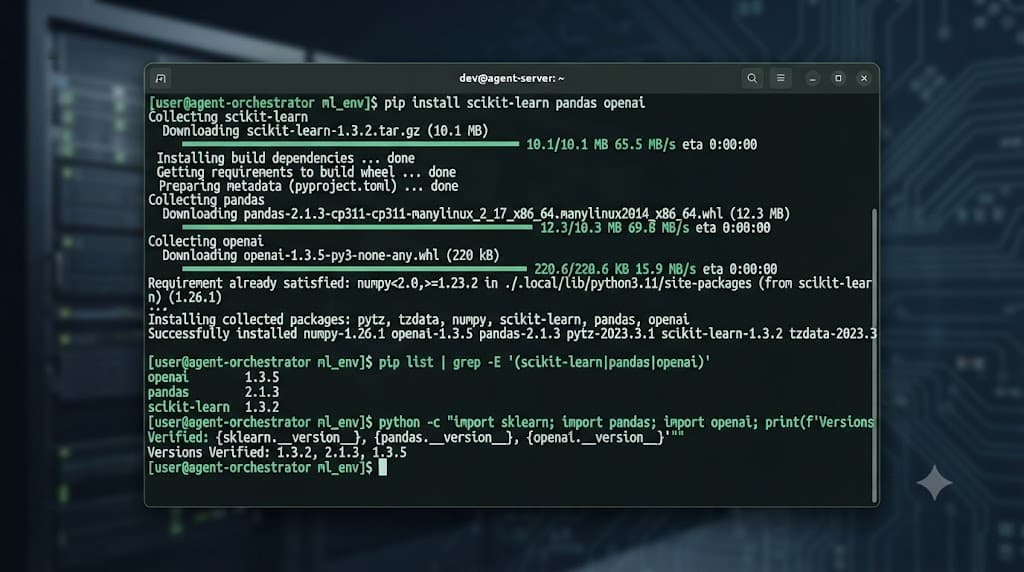
Executing a reliable hermes agent install requires a clean virtual environment to prevent package pollution or version conflicts with global Python libraries. Follow these precise terminal commands to set up your workspace and install the agent cleanly.
First, create and activate a dedicated virtual environment:
python3 -m venv hermes-env
source hermes-env/bin/activate
Next, upgrade your local pip installation and install the core package along with standard developer dependencies:
python3 -m pip install --upgrade pip
pip install hermes-agent
If you are performing a hermes agent quickstart on an Ubuntu or Debian-based Linux host, you may also need to install build essentials if compiling native extensions:
sudo apt update && sudo apt install -y build-essential libssl-dev libffi-dev python3-dev
Upon successful execution, your terminal will display confirmation messages indicating that all dependency wheels have been downloaded and built successfully.
Native Installation vs. Containerized Setup
Choosing between a bare-metal native installation and a containerized Docker deployment depends on your operational goals, infrastructure maturity, and isolation requirements.
✓ Native Advantages
- Direct hardware and local file access
- Lower latency for local model inference
- Faster iteration during local development
✕ Native Limitations
- Potential dependency conflicts on host system
- OS-specific troubleshooting required
- Harder to replicate across different machines
Containerized setups isolate the runtime inside an immutable image, making production deployments reproducible. However, native installations provide immediate feedback loops, making them ideal for initial evaluation and local script automation.
First-Run Configuration and Model Setup
Once the package is installed, configuring your agent's behavior and connecting it to a supported model provider is the next critical milestone. Hermes Agent relies on environment variables or a local configuration YAML file to manage authentication tokens and default inference parameters.
Create a configuration directory and initialize your settings file:
mkdir -p ~/.config/hermes
cat << EOF > ~/.config/hermes/config.yaml
model_provider: "openai"
default_model: "gpt-4o"
max_tokens: 2048
temperature: 0.2
EOF
[!TIP] Pro Tip: Store your sensitive API keys inside your shell profile or use a dedicated secrets manager rather than hardcoding them into configuration files.
Export your provider credential securely in your terminal session:
export OPENAI_API_KEY="sk-..."
With credentials in place, you can proceed to execute verification routines and test end-to-end connectivity.
Verification, Warnings, and Troubleshooting
Completing your hermes agent installation requires validating that the agent can initialize, parse configurations, and communicate with your chosen AI backend without throwing runtime exceptions.
Run the built-in diagnostic test command to check connectivity:
hermes doctor
If the command returns status checks with green confirmation markers, your setup is complete. If you encounter common errors such as ModuleNotFoundError or permission denied faults on Linux/WSL environments, verify that your virtual environment is actively sourced and that your user account possesses appropriate write permissions to the configuration directory.
[!WARNING] Warning: Command syntax and API parameters evolve rapidly. Always cross-reference your configuration blocks against the official project repository guidelines before deploying to production environments.