Quick Answer
Evaluating modern artificial intelligence and large language model systems requires rigorous, deterministic conditions. Yet, engineering teams frequently struggle with environment drift, hidden state dependencies, and unrepeatable benchmarks. When an evaluation pipeline produces different scores for the exact same model weights simply because a Python package updated on a host machine, trust in the entire validation suite collapses. Standardizing the execution surface is no longer optional for rigorous machine learning operations; it is a foundational requirement.
Introduction to AI Evaluation Challenges
Traditional AI evaluation setups often rely on shared developer workstations, persistent virtual environments, or loosely managed cloud instances. These approaches introduce severe vulnerabilities into the software development lifecycle. Over time, manual package installations, cached pip wheels, and unversioned system libraries accumulate silently. As a result, an evaluation script that passes cleanly today might fail or yield altered numeric outcomes tomorrow due to ambient system changes.
Furthermore, modern AI evaluation involves complex scoring harnesses, external benchmark datasets, and stochastic model generations. Without strict isolation, side-effects from prior test runs can bleed into subsequent evaluations. For instance, temporary files left in shared directories or modified global configurations can subtly skew latency metrics or accuracy scores. This lack of deterministic baseline conditions makes comparative benchmarking across different model checkpoints unreliable, frustrating engineers who need absolute confidence before pushing artifacts to production.
[!WARNING] Warning: Relying on host-level Python environments for LLM evaluation guarantees silent environment drift over time.
Another critical hurdle is the challenge of capturing comprehensive runtime evidence. When an evaluation metric drops unexpectedly, debugging requires deep insight into exact system calls, memory footprints, and hardware utilization states during the test execution. Standard logging often captures only high-level application outputs, omitting vital low-level signals needed for root-cause analysis.
How Docker Sandboxes Streamline AI Testing
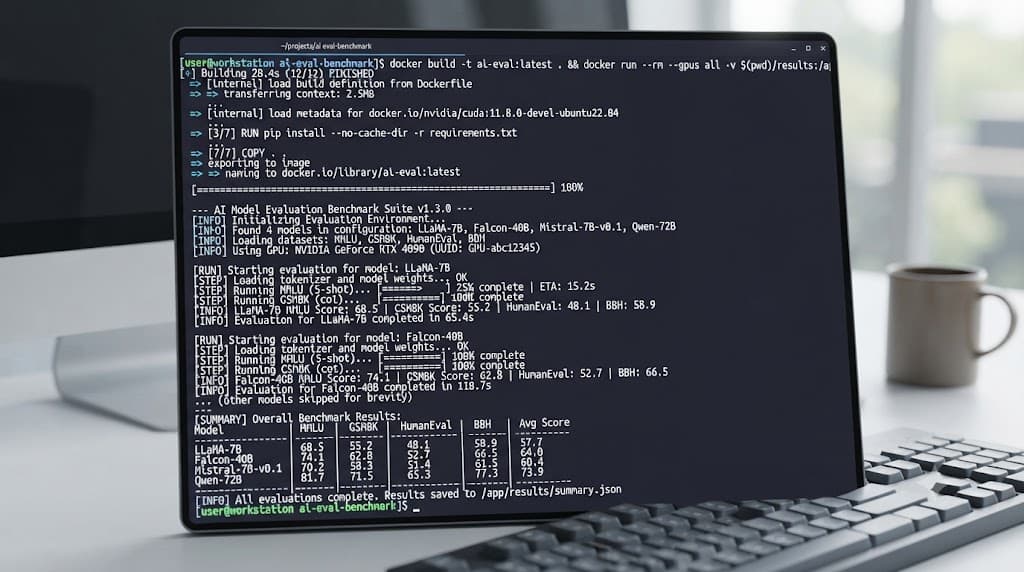
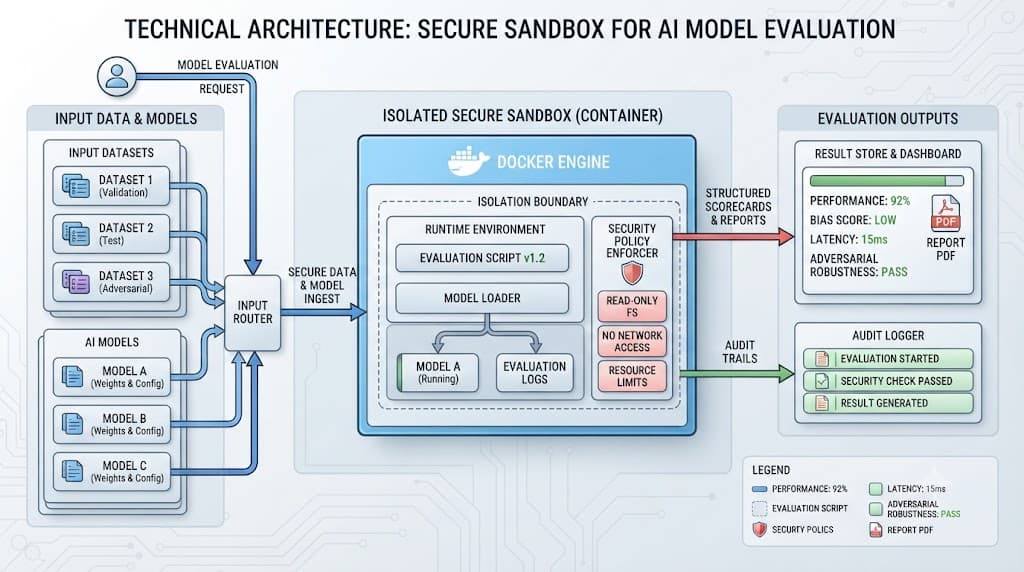
Leveraging containerization transforms chaotic evaluation setups into predictable, isolated workflows. Docker Sandboxes provide a pristine, ephemeral runtime environment where every dependency, from CUDA drivers to custom tokenizers, is explicitly declared within a immutable image definition. By encapsulating the entire execution graph, teams eliminate host contamination and ensure that every test run starts from an identical clean slate.
Structured artifacts are another core advantage of sandbox-based execution. During an AI evaluation run, multiple outputs are generated, including classification matrices, token-level latency breakdowns, generated completions, and aggregate scorecards. In a sandbox architecture, these files are explicitly written to designated volume mounts or extracted cleanly upon container termination. This guarantees that evaluation outputs are never lost or mixed with residual cache data from previous runs.
Runtime evidence collection becomes seamless when execution happens inside a controlled container. Because resource constraints, network access, and filesystem modifications can be closely monitored or restricted, security and auditability improve dramatically.
[!TIP] Pro Tip: Mount evaluation datasets as read-only volumes to prevent accidental data mutation during test execution.
| Feature | Standard Host Environment | Docker Sandbox Environment |
|---|---|---|
| Reproducibility | Low (prone to system drift) | High (fully version-controlled images) |
| Isolation | Shared kernel state and global paths | Strict network and filesystem boundaries |
| Artifact Management | Manual file copying and clutter | Automated extraction via clean volumes |
| Auditability | Difficult to track ambient changes | Complete container specification trails |
Implementing a Reproducible Evaluation Workflow
Integrating containerized sandboxes into existing continuous integration pipelines requires a structured, multi-stage approach. The process begins by crafting a robust Dockerfile that specifies the exact operating system base, runtime libraries, and evaluation dependencies needed for your specific benchmark suite.
FROM python:3.10-slim
WORKDIR /app
RUN apt-get update && apt-get install -y --no-install-recommends git
COPY requirements.txt .
RUN pip install --no-cache-dir -r requirements.txt
COPY . /app
ENTRYPOINT ["python", "run_evaluation.py"]
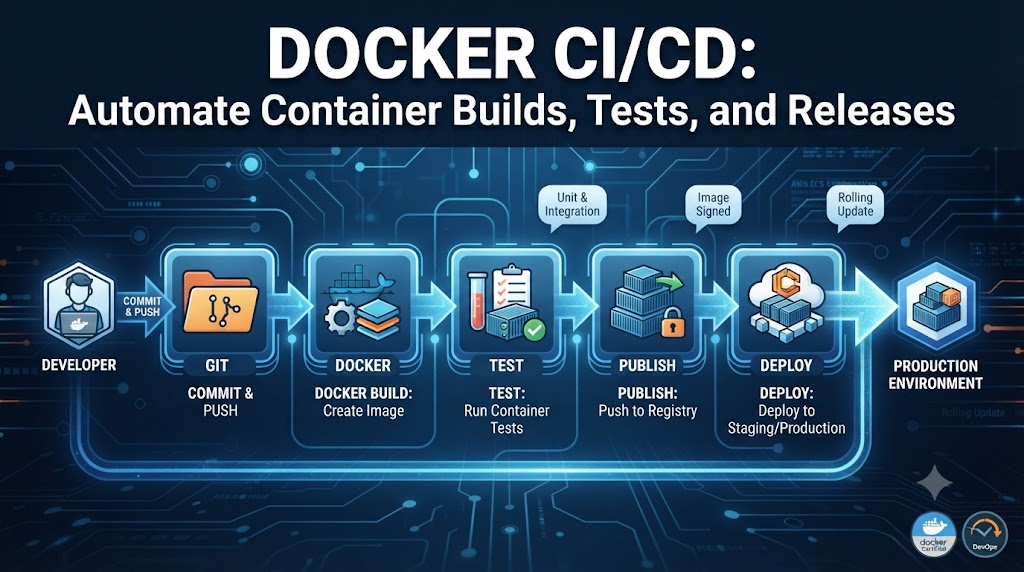
Once the base image is built and tagged, the next step is orchestration. Your CI/CD runner spins up the container instance, injecting the model weights and benchmark datasets securely via environment variables or mounted volumes. The evaluation script executes entirely within the isolated container, calculating metrics without interference from external host processes.
Upon completion, the container automatically exports its structured results to a designated storage bucket or pipeline artifact repository. The container instance is then destroyed, leaving zero footprint on the host runner. This lifecycle pattern guarantees absolute parity between local developer debugging sessions and automated production pipelines, ensuring robust and trustworthy AI evaluation every single time.