Quick Answer
Understanding how modern technology works requires looking at the foundational relationship between clients and servers. At the core of virtually every digital experience, from browsing a website to sending a message on a mobile application, lies the client-server model. This model defines how different devices and software systems communicate with each other over a network. To grasp system design basics, one must first clearly define what a client and a server are.
Introduction to Clients and Servers
A client is a device or software application that initiates a request for a service, data, or resource. A server, on the other hand, is a dedicated system or software program that listens for incoming requests, processes them, and returns the appropriate response. In technical terms, the client is the consumer of a service, and the server is the provider.
To understand this relationship intuitively, consider a real-world scenario at a local restaurant or shop. Imagine a customer walking up to a counter to place an order. The customer represents the client, as they want a specific item and make a request. The shopkeeper represents the server, as they receive the request, go to the inventory to process it, and hand back the requested item as a response. The communication flows in a simple cycle: the customer submits a request, the shopkeeper fulfills it, and the customer receives the response.
Translating this to software, the interaction follows the exact same pattern. The client application generates a request, the server receives and processes that request, and the server sends back a response. Clients can manifest as web browsers, mobile applications running on smartphones, desktop software, or even Internet of Things devices. Servers can manifest as web servers delivering static files, application servers executing complex business rules, or database servers managing persistent storage.
The Request-Response Cycle in Action
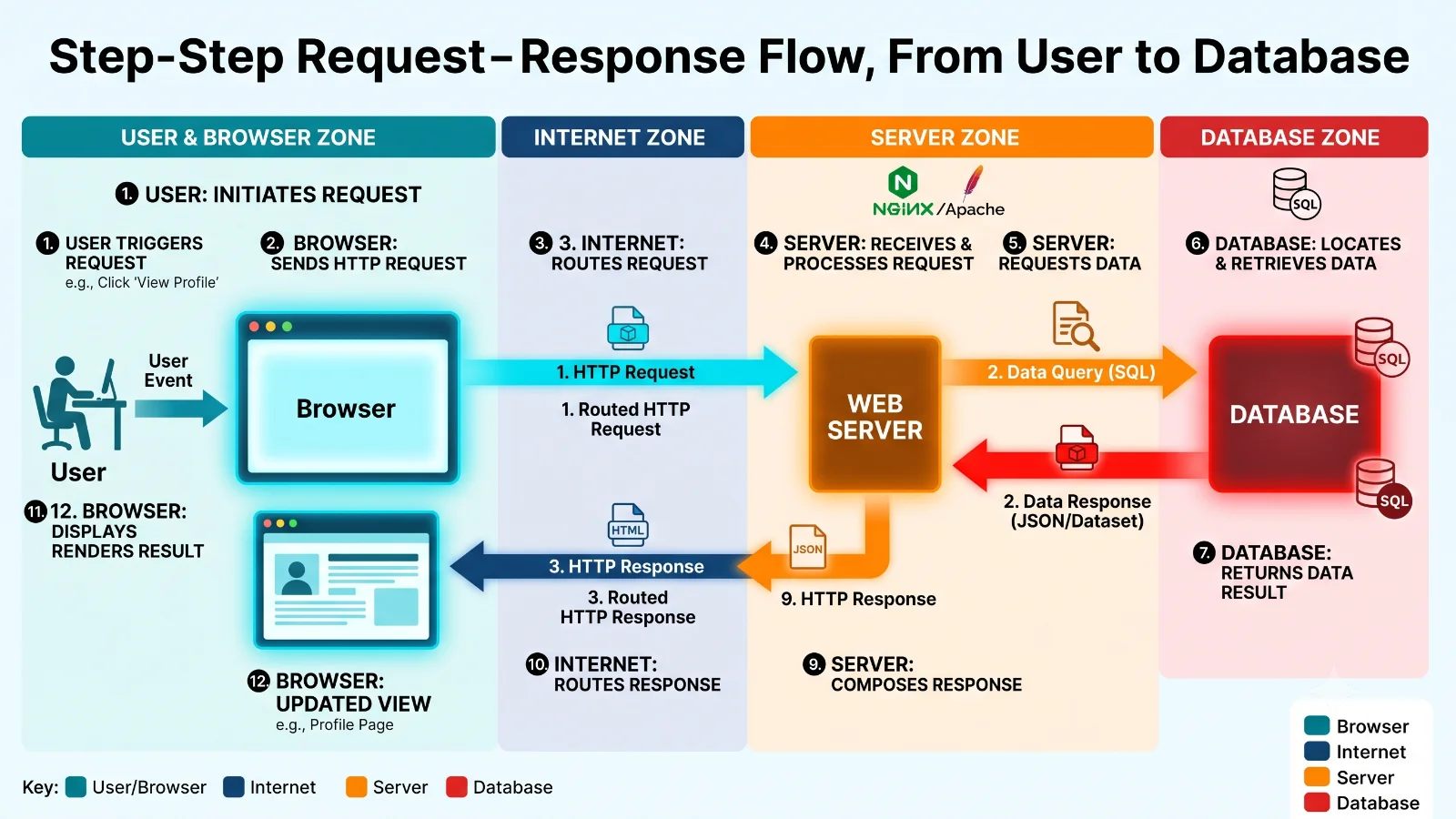
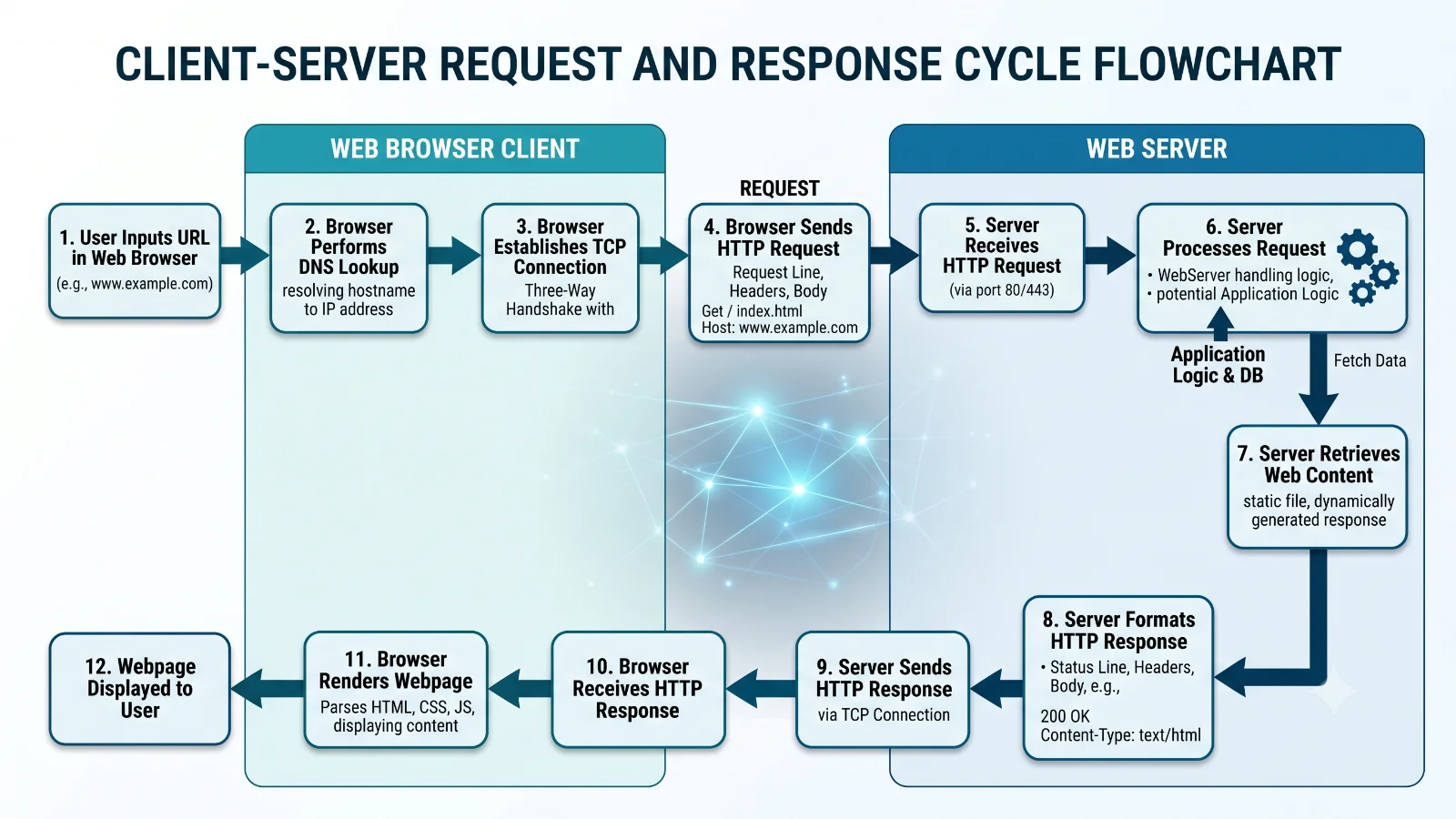
When a user opens a web browser and navigates to a website, a structured sequence of events takes place behind the scenes. This sequence is known as the request-response cycle and forms the backbone of client server communication.
First, the user interacts with a web browser, such as entering a URL or clicking a link. The browser acts as the client. Second, the client packages the user's intent into an HTTP request and sends it across the internet to the designated web server. Third, the web server receives the incoming request and routes it to the appropriate application logic or web server software. Fourth, the server may execute business logic or communicate with a database to retrieve relevant information, such as user account details or product catalogs. Fifth, once the data is gathered and processed, the server prepares a structured response containing the requested webpage, data, or status code. Sixth, the response is transmitted back across the network to the client. Finally, the browser parses the response, renders the visual elements, and displays the final result to the user.
Throughout this cycle, the distinction between a request and a response is clear. A request is a message sent by the client asking for action or data, such as requesting a webpage, logging into an application, retrieving a user profile, or submitting an online form. A response is the message returned by the server containing the outcome, data, or error message.
Server-Side Responsibilities and Security
As applications grow in complexity, the division of labor between the client and the server becomes critical for maintaining performance, security, and data integrity. The server side assumes heavy responsibilities, including business logic execution, user authentication, identity authorization, data validation, complex data processing, and database interaction. It is important to note that not every single request requires all of these operations; a simple request for a static image might only require the web server to fetch a file, whereas a financial transaction request will trigger authentication, validation, business rule checks, and database updates.
Applications deliberately avoid placing sensitive business logic, credentials, and direct database access on the client side. If critical business rules or database credentials lived entirely within a browser or mobile app, malicious users could inspect, modify, or bypass them. Keeping vital logic and direct data access on controlled server-side systems ensures robust security, maintains data consistency, enforces centralized business rules, and simplifies application management and updates.
Expanding Beyond Web Browsers
While web browsers are the most familiar examples of clients, client-server communication is not limited to desktop web browsing. Mobile applications, desktop software utilities, smart home appliances, and connected industrial sensors all act as clients that communicate with remote servers over networks.
In modern system design, a single server often needs to handle requests from thousands or even millions of clients simultaneously. This high volume of concurrent traffic can create significant performance, scalability, and availability challenges. When many clients request data at the same time, servers can experience high CPU usage, memory constraints, and network bottlenecks. Understanding how systems scale to meet these demands introduces advanced concepts like load balancing and distributed architectures, which build directly upon the foundational principles of the client-server model.
This overview of client server architecture establishes the groundwork for exploring how data actually travels across networks. In the next stages of the system design series, you will explore foundational networking concepts including IP addresses, the Domain Name System, the HTTP and HTTPS protocols, and other core components that make web communication possible.