Quick Answer
Production database environments face a constant barrage of threats, ranging from subtle application bugs to catastrophic human error. Whether a developer accidentally executes an unconstrained UPDATE statement in the dead of night or a rogue migration corrupts critical customer state, database administrators live in perpetual fear of data integrity incidents. In standard relational database management systems, recovering from these self-inflicted wounds is notoriously slow, resource-intensive, and prone to extended downtime. This operational reality has forced systems architects to look beyond traditional engines and explore specialized forks designed specifically to solve the age-old nightmare of instant database mistake recovery. Enter EterDB: a purpose-built PostgreSQL fork engineered to integrate native undo logs directly into the storage layer, fundamentally transforming how historical data versions and state rollbacks are handled.
Introduction
The ability to recover gracefully from unexpected data anomalies is the defining characteristic of an enterprise-grade database platform. In modern cloud-native architectures, microservices write to shared datastores at blistering speeds, making mistakes exponentially harder to catch before they propagate downstream. When an erroneous operation corrupts production tables, organizations typically rely on cold backups, point-in-time recovery pipelines, or manual counter-transactions. Unfortunately, each of these conventional methods introduces severe operational bottlenecks. Cold restores require shutting down active workloads or provisioning entirely parallel clusters, leading to unacceptable Recovery Time Objectives (RTO). Meanwhile, complex application-level compensating transactions often fail due to foreign key constraints, triggers, or partial writes.
EterDB approaches this challenge from a completely different angle by questioning a foundational assumption of traditional relational storage: that recovery must be decoupled from normal transaction processing. By baking incident recovery directly into the core engine storage mechanics, EterDB eliminates the friction associated with restoring accidental changes. This architectural shift bridges the gap between high-speed transactional throughput and instant, surgical rollback capabilities. For systems architects evaluating database forks for high availability and disaster recovery, understanding how EterDB achieves this without sacrificing standard PostgreSQL compatibility is essential for designing resilient infrastructure.
What Standard PostgreSQL Is and Its Recovery Model
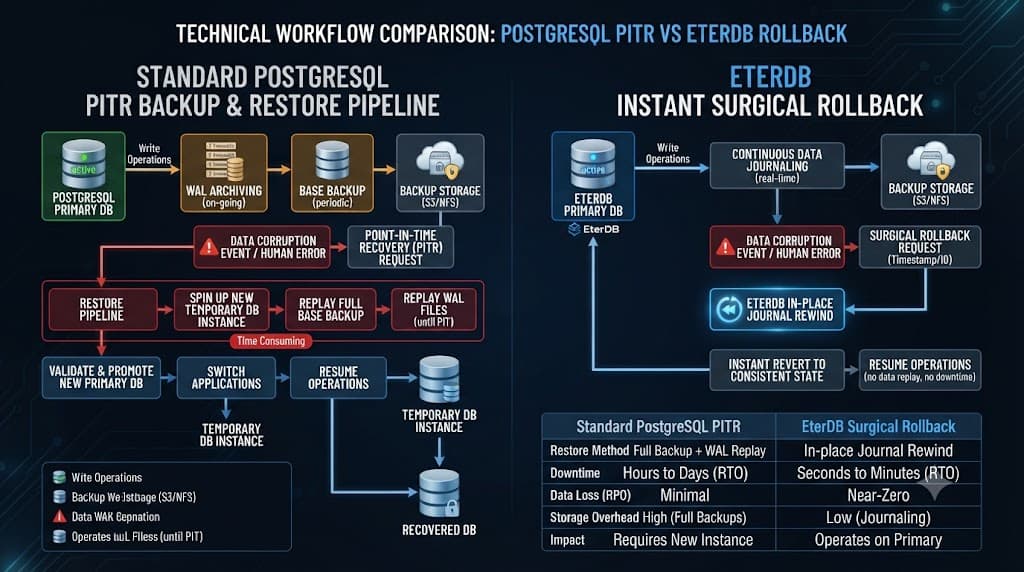
To appreciate the architectural breakthroughs of EterDB, we must first examine the storage and recovery mechanisms that power standard PostgreSQL. At its core, PostgreSQL relies on a Write-Ahead Logging (WAL) architecture. Before any data modification is written to the primary data pages on disk, a record of the change is appended to the WAL sequence. This design ensures durability and crash recovery, allowing the database to replay transactions after an unexpected power outage or kernel panic. However, WAL is fundamentally a forward-looking log optimized for durability and replication, not for surgical, backward-looking incident recovery.
When a catastrophic mistake occurs in standard PostgreSQL—such as deleting millions of rows without a WHERE clause—the recovery process is notoriously arduous. Administrators must turn to Point-in-Time Recovery (PITR), which involves restoring a base backup to a separate staging environment and replaying the WAL stream up to the exact transaction boundary just prior to the mistake. This process is illustrated in the standard recovery pipeline below:
[!WARNING] Warning: Relying solely on standard PostgreSQL PITR for human-error mitigation can result in hours of downtime and data loss for all transactions that occurred after the mistake, since PITR rolls back the entire database cluster globally rather than isolating a specific erroneous table or row update.
Furthermore, standard PostgreSQL utilizes an append-only MVCC (Multi-Version Concurrency Control) model where old row versions (tuples) remain in place until vacuumed away. While this supports general transaction isolation, it does not provide an efficient, indexed history mechanism for rolling back individual user mistakes without heavy administrative intervention. Vacuum processes reclaim space asynchronously, meaning historical states are intentionally discarded rather than preserved for emergency mitigation.
What EterDB Is and Its Core Architectural Innovations
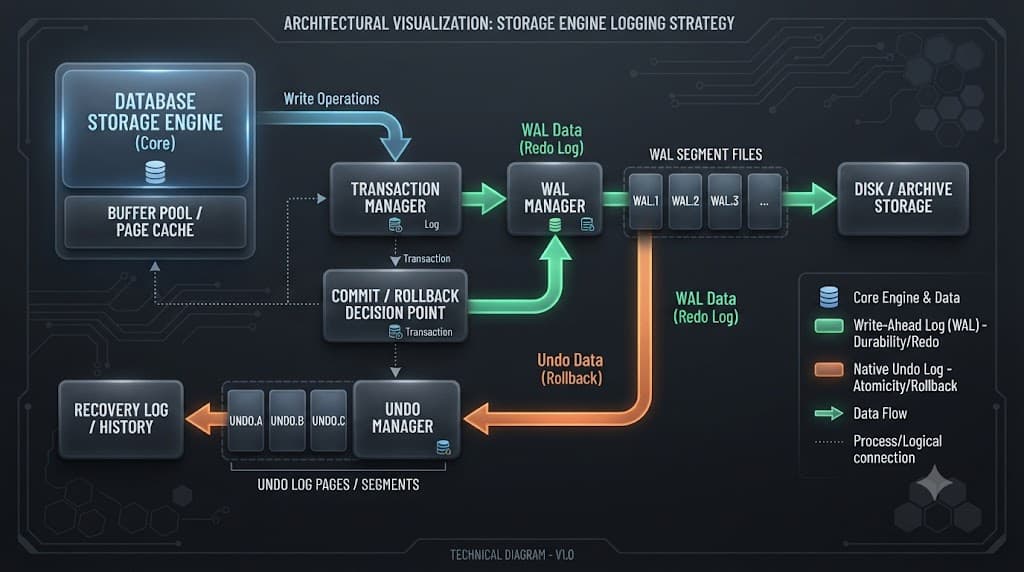
EterDB is a specialized PostgreSQL fork designed from the ground up to solve the operational nightmare of instant database mistake recovery. Instead of treating recovery as an external operational procedure involving backups and log replay, EterDB redesigns the internal storage engine to maintain native undo logs. This innovation allows the database to keep precise, highly efficient historical versions of modified data directly alongside active tuples, completely changing how rollbacks are executed.
In EterDB, when a transaction updates or deletes a row, the prior state is written to a dedicated undo log structure rather than relying solely on traditional WAL or immediate tuple overwrites. This native undo log architecture provides several profound architectural advantages:
- Surgical Rollbacks: Administrators can target specific transactions, queries, or time windows and roll them back instantly without touching unrelated tables or interrupting concurrent user traffic.
- Reduced RTO: Because historical states are maintained natively within the storage engine, recovery operations execute in milliseconds rather than hours.
- Predictable Overhead: Undo log pruning is managed efficiently by background workers, preventing uncontrolled bloat while retaining immediate rollback windows.
[!NOTE] Background Note: EterDB maintains full wire-protocol and query-parser compatibility with standard PostgreSQL, ensuring that existing ORMs, connection poolers, and client drivers connect without modification.
Key Differences: EterDB vs Standard PostgreSQL
Comparing EterDB vs standard PostgreSQL reveals a fundamental divergence in storage philosophy. While standard PostgreSQL prioritizes classic block-level MVCC and forward-only WAL durability, EterDB extends this foundation with inline undo mechanics tailored for high-availability environments where human error is an inevitable operational risk.
The core differences manifest across three primary operational axes: log structure, resource utilization during recovery, and administrative complexity. In standard PostgreSQL, rolling back a bad data modification requires either writing complex reverse SQL scripts or executing a full cluster-level PITR restore. Both approaches carry massive risk. Reverse scripts frequently fail due to complex relational constraints, triggers, and cascading deletes, while PITR destroys all legitimate transactions that occurred after the error.
EterDB bypasses this dilemma entirely by decoupling error recovery from cluster restoration. Because the undo logs are maintained natively within the storage engine, executing a rollback operates as a high-speed logical reversal rather than a brute-force physical restore. This architectural shift redefines Recovery Time Objectives (RTO) from hours down to sub-second thresholds, making it a powerful tool for mission-critical enterprise applications.
Comparison Table
To clearly evaluate how EterDB compares against the standard database engine, the matrix below contrasts key operational and architectural metrics.
| Architectural Metric | Standard PostgreSQL | EterDB (PostgreSQL Fork) |
|---|---|---|
| Primary Recovery Model | Write-Ahead Log (WAL) & PITR | Native Undo Logs + WAL |
| Recovery Time Objective (RTO) | Hours (requires backup restore & replay) | Seconds / Instant (surgical rollback) |
| Recovery Point Objective (RPO) | Dependent on archive frequency | Zero data loss for non-erroneous txns |
| Rollback Granularity | Cluster-wide or manual counter-query | Table, row, or transaction level |
| Storage Overhead | Standard MVCC bloat (vacuum-dependent) | Controlled undo log retention space |
| Ecosystem Compatibility | Universal standard | High (PostgreSQL wire/parser compatible) |
When to Use Standard PostgreSQL
Despite the advanced recovery capabilities offered by specialized forks, standard PostgreSQL remains the gold standard for the vast majority of traditional workloads. Organizations with highly stable applications, rigorous change-management pipelines, and robust testing frameworks may find that standard PostgreSQL satisfies all operational requirements without introducing the specialized dependency of a database fork.
Standard PostgreSQL is the optimal choice when:
- Workloads are read-heavy or append-only: Applications such as time-series log ingestion, IoT event collectors, and analytics reporting engines rarely suffer from destructive update/delete mistakes.
- Ecosystem and extension purity is paramount: Organizations that rely on obscure, bleeding-edge PostgreSQL extensions maintained by third parties benefit from running unmodified upstream binaries.
- Managed cloud services are mandatory: Teams tied strictly to managed database offerings like Amazon RDS, Google Cloud SQL, or Azure Database for PostgreSQL cannot easily deploy custom forks without relinquishing managed control plane features.
When to Use EterDB
Deploying EterDB makes strategic sense in high-stakes production environments where the cost of human error, accidental data corruption, or failed migrations results in catastrophic financial or reputational loss. Systems architects running complex multi-tenant microservices or rapid CI/CD deployment pipelines where developers have direct database access often find that traditional recovery models simply cannot meet modern SLA demands.
EterDB delivers maximum return on investment in scenarios such as:
- High-Frequency Enterprise CRUD Applications: Fast-paced product environments where frequent updates and deletes increase the statistical likelihood of accidental data loss.
- Mission-Critical Microservices: Systems where downtime translates directly to lost revenue, making an instantaneous RTO mandatory.
- Autonomous Operations & AI Agents: As organizations experiment with autonomous database agents executing automated queries and migrations, having native undo-log protection provides an essential safety net against automated mistakes.
✓ EterDB Advantages
- Instant surgical rollbacks without cluster downtime
- Eliminates complex point-in-time recovery restore pipelines
- Native undo logs preserve historical states efficiently
- Maintains full PostgreSQL wire and query compatibility
✕ Considerations
- Requires managing a customized database fork binary
- Additional storage overhead required for undo log retention
- Fewer managed cloud provider options out of the box
- Requires team training on native rollback tooling