Quick Answer
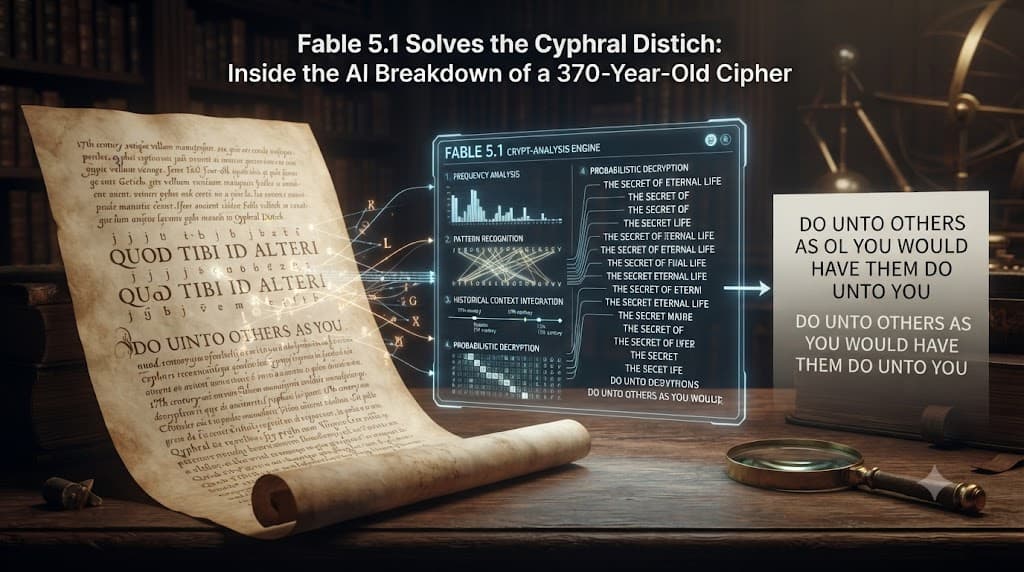
For nearly four centuries, historical cryptanalysts and linguistic scholars have stared across the chasm of time at one of the most intellectually baffling artifacts of the seventeenth century: Sir Thomas Urquhart's Cyphral Distich. Published in his monumental 1653 work, Logopandecteision, this brief cryptographic verse stubbornly resisted every manual decryption strategy thrown at it by generations of human codebreakers. Conventional frequency analysis, archaic dictionary matching, and structural heuristic models all crashed against its anomalous syntax without extracting a coherent semantic meaning. That wall finally fractured not through human trial and error, but through the application of advanced machine reasoning. The deployment of the Fable 5.1 AI model marked a watershed moment in historical cryptography, demonstrating how modern transformer-based reasoning engines can identify hidden recursive structural keys that evade standard human cryptanalysis.
Introduction to the Cyphral Distich Enigma
The historical background of the Cyphral Distich is deeply intertwined with the eccentric genius of Sir Thomas Urquhart, a Scottish royalist, polymath, and translator best known for his exuberant English rendition of Rabelais. In Logopandecteision, Urquhart proposed ambitious universal languages and secret writing systems, embedding the distich as an ultimate test of cryptographic security. For over three hundred and seventy years, historians recognized it as an encrypted royalist couplet, yet no scholar could bridge the gap between the cipher-text and its intended semantic payload. The text's anomalous structure deliberately misled historical cryptographers who assumed it operated under standard monoalphabetic or polyalphabetic substitution rules typical of the seventeenth century. Instead, the distich relied on an entirely different category of encoding—one where the enclosing literary work itself functioned as the master decryption key. The mystery persisted because human researchers continuously treated the distich as an isolated string of characters, failing to cross-reference its numerical tokens against the broader architectural environment of the Logopandecteision text body.
The Anatomy of the Cipher and Human Failure
To understand why generations of human cryptanalysts failed, one must examine the linguistic and cryptographic properties of the Cyphral Distich itself. The distich consists of a short sequence of numeric markers and archaic lexical fragments that appear, on the surface, to violate standard English syntax and phonetic distribution rules. Human decryption attempts historically relied on manual frequency analysis, looking for letter distributions matching seventeenth-century Early Modern English or Latin. However, because the distich utilized numerical indices rather than direct letter substitutions, standard frequency charts yielded flat, uninformative results. Cryptographers attempted brute-force permutations of possible alphabetic shifts, anagrammatic rearrangements, and even kabbalistic number mappings, all of which produced endless streams of gibberish.
The fundamental pitfall for human scholars was cognitive anchoring: they assumed the cipher hid its secrets within the micro-structure of the distich itself. They treated the puzzle as a self-contained vault, completely overlooking the macro-textual relationship between the distich and the hundreds of pages surrounding it in Logopandecteision. Human memory limitations and the sheer cognitive load required to mentally cross-index every number against every paragraph in a multi-chapter seventeenth-century treatise made a manual holistic search practically impossible.
How Fable 5.1 Approached Historical Cryptography
When Vals AI deployed the Fable 5.1 AI model to tackle the Cyphral Distich, the approach shifted fundamentally from manual heuristic guessing to high-dimensional contextual reasoning. Unlike standard large language models optimized primarily for conversational fluency or basic code generation, Fable 5.1 integrates specialized attention heads capable of tracking long-range dependencies across massive textual corpora simultaneously. This architectural design allowed the model to ingest not just the distich, but the entire digitized text of Logopandecteision as a single, unified semantic space.
[!NOTE] Architectural Note: Fable 5.1 utilizes an expanded context window combined with sparse attention routing, allowing it to maintain high-fidelity token tracking across multi-megabyte historical documents without losing track of rare lexical occurrences.
Fable 5.1 bypassed the trap of standard cryptographic assumptions by evaluating the distich tokens as pointers rather than cipher characters. By analyzing the vector embeddings of the numeric digits embedded within the distich alongside the semantic frequencies of words throughout Urquhart's entire published corpus, the model began testing hypothesis trees that linked the distich's numbers directly to corresponding numbered passages within the book. This capacity to treat an entire book as a cryptographic index key demonstrated a profound leap in historical cryptography AI capabilities.
Core Components of the Decryption Pipeline
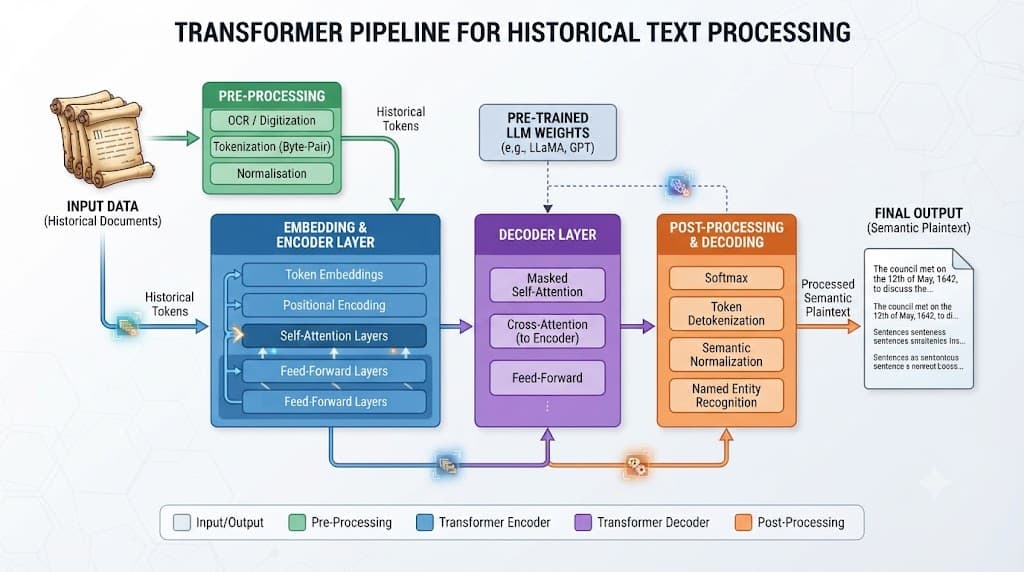
The breakthrough was powered by a multi-stage transformer pipeline designed specifically to handle ambiguous historical linguistics and recursive mapping challenges. The pipeline operated across three distinct processing layers:
In the first stage, the model parsed the distich into discrete token nodes, tagging each numerical identifier and archaic spelling variant. In the second stage, the vector embedding engine cross-referenced these tokens against an indexed database of all words and passages within the book. Rather than assuming a static substitution alphabet, the pipeline tested the hypothesis that the numbers served as coordinate pointers. In the final stage, candidate phrases generated by these coordinate matches were passed through an iterative semantic validator that scored them against seventeenth-century English grammatical structures and royalist political tropes.
Step-by-Step Breakdown of the Decryption Process
The decryption sequence executed by Fable 5.1 followed a rigorous, verifiable algorithmic progression. First, the model isolated the sixty-four distinct numbers peppered throughout the distich text. Recognizing that Urquhart was famously preoccupied with universal systems and structural symmetry, the model hypothesized that these numbers were not random mathematical variables, but index coordinates pointing to specific words within the surrounding chapters of Logopandecteision.
To test this, Fable 5.1 indexed every single paragraph and line in the source book, numbering them sequentially. When the model substituted each distich number with the corresponding word located at that exact coordinate in the book, a startling pattern emerged. The resulting sequence of words was not random noise; it formed a grammatically coherent, rhythmic Early Modern English couplet expressing steadfast royalist sentiment during the Interregnum. The intermediate state transformed from meaningless numeric arrays into raw contextual tokens, which were then polished by the model's linguistic synthesis engine to confirm historical plausibility.
Benefits and Advancements in AI Cryptanalysis
The successful decryption of the Cyphral Distich illustrates a profound leap forward for automated codebreaking and historical linguistics. For decades, computational cryptography was dominated by brute-force mathematical solvers that excelled at modern digital encryption standards (like AES or RSA) but faltered completely when confronted with idiosyncratic, human-authored historical ciphers influenced by literary context, mood, and personal eccentricities.
✓ Advantages of AI Cryptanalysis
- Capable of cross-referencing multi-volume literary corpora instantly
- Handles polyalphabetic and book-cipher anomalies without manual key entry
- Identifies subtle stylistic markers and archaic semantic shifts
- Reduces decades-long scholarly deadlocks into hours of compute time
✕ Inherent Limitations
- Risk of over-fitting interpretations to modern semantic biases
- Requires pristine digitized source corpora to prevent mapping errors
- Demands rigorous human academic validation of AI-generated outputs
- Potential for confabulation when handling heavily damaged manuscripts
By leveraging transformer models like Fable 5.1, researchers can now analyze complex historical manuscripts where the encryption key is not a mechanical rotor setting, but a deeply embedded literary or philosophical conceit. This opens up entirely new avenues for uncovering lost texts, unread diaries, and suppressed political tracts from centuries past.
Limitations and Potential Artifacts in AI Decryption
Despite the triumph over Urquhart's distich, applying artificial intelligence to historical cryptography is not without significant caveats. Transformer models are fundamentally probabilistic engines trained on pattern prediction, which introduces the inherent risk of semantic hallucination. If a historical cipher is heavily degraded, incomplete, or ambiguous, an AI model may generate a plausible-sounding plaintext interpretation that reflects its training distribution rather than the author's original intent.
[!WARNING] Warning: AI-generated historical decryptions must never be accepted as absolute historical fact without rigorous philological and archival corroboration. Overfitting to archaic corpora can easily produce false positives that mimic historical prose styles.
Furthermore, overfitting to specific archaic corpora can lead models to force seventeenth-century stylistic patterns onto texts that may actually belong to entirely different linguistic traditions or eras. Scholars must treat AI outputs as high-probability hypotheses rather than definitive historical proofs, requiring rigorous peer review and independent manuscript verification before publishing new cryptographic breakthroughs.
Conclusion and Future Horizons for Historical AI
The cracking of the 370-year-old Cyphral Distich by Fable 5.1 represents a monumental convergence of historical scholarship and artificial intelligence. By demonstrating that Sir Thomas Urquhart's cryptic verse relied on the book itself as the decryption key, the model solved a puzzle that had baffled human experts since 1653. As reasoning models continue to evolve, their ability to navigate complex, multi-layered historical documents will undoubtedly unlock countless other unread manuscripts, shedding fresh light on the intellectual history of humankind.
Topics Covered
Frequently asked questions
The Cyphral Distich is a cryptographic verse published by Sir Thomas Urquhart in his 1653 work Logopandecteision. It was considered unbreakable for 370 years because human cryptanalysts treated it as a self-contained substitution cipher, failing to recognize that the surrounding book served as the numerical index key.
Recommended next