Quick Answer
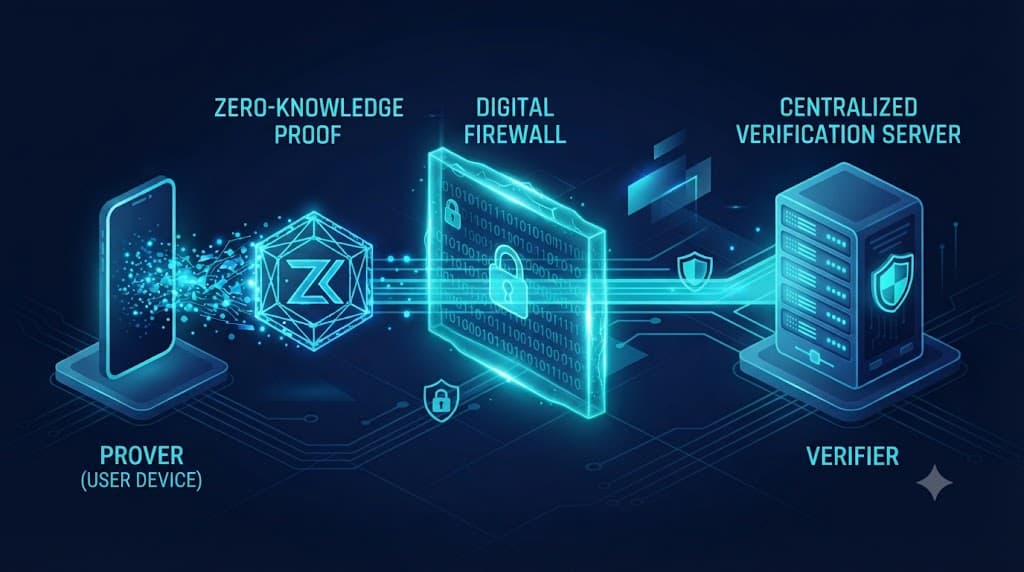
For over a decade, end-to-end encrypted messaging applications have relied on the humble phone number as the foundational pillar of identity routing. While this mechanism simplified contact discovery and onboarding for billions of users, it introduced a significant metadata vulnerability. Your telephone number acts as a permanent, publicly visible anchor linking your cryptographic identity to real-world infrastructure, telecommunications carriers, and potential adversaries. The engineering challenge of decoupling identity from verifiable registration without opening the floodgates to automated abuse has long been one of the holy grails of applied cryptography. Signal's zero-knowledge proof registration protocol solves this exact conundrum, creating a cryptographic firewall between user identities and centralized directory servers.
Introduction
The traditional reliance on phone numbers in secure communication software forces a difficult security compromise. On one hand, users expect seamless address book matching so they can immediately message friends, family, and colleagues. On the other hand, storing phone numbers alongside cryptographic public keys in centralized databases exposes users to scraping, deanonymization attacks, and targeted carrier compromises like SIM swapping. To mitigate these risks, systems engineers must design protocols that prove eligibility—such as verifying that a user owns an active phone number or holds a legitimate service token—without ever transmitting or storing that raw identifier on remote servers. Signal without phone number zero knowledge proof architectures represent a paradigm shift, transitioning trust from centralized administrative databases to trustless mathematical proofs computed directly on user hardware.
[!NOTE] Architectural Note: Traditional directory servers require raw phone numbers hashed with static salts. ZKP registration replaces these weak hashes with algebraic proofs of set membership and credential possession.
Definition
At its core, a zero-knowledge proof is a cryptographic protocol enabling one party, the prover, to prove to another party, the verifier, that a given statement is true without conveying any information beyond the mere statement's validity. In the context of distributed messaging protocols and anonymous messaging app registration zero knowledge proofs, three fundamental mathematical properties must hold: completeness, soundness, and zero-knowledge. Completeness ensures that if the statement is true, an honest verifier will be convinced by an honest prover. Soundness guarantees that a cheating prover cannot convince the verifier of a false statement except with negligible probability. Zero-knowledge ensures that the verifier learns absolutely nothing other than the fact that the statement is true.
When applied to modern messaging infrastructure, these properties allow a client application to convince the Signal authentication servers that it possesses a valid authorization credential—such as a signed token proving subscription to a legitimate telecommunication network or payment tier—without revealing the underlying phone number or credential itself. This is typically achieved using non-interactive zero-knowledge succinct arguments of knowledge, or zk-SNARKs, which compress complex arithmetic circuits into small cryptographic proofs that can be verified in milliseconds.
How it Works
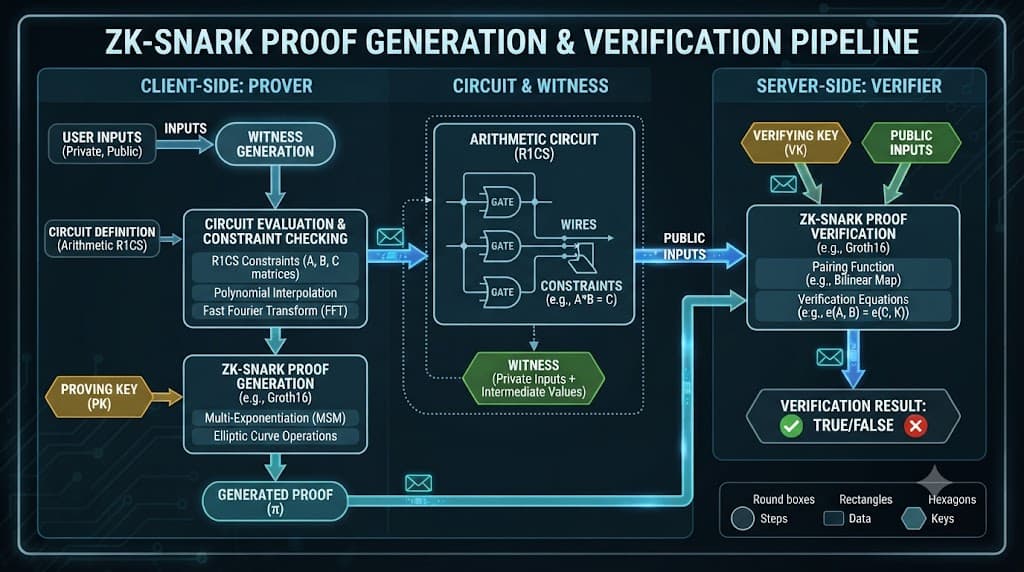
The operational workflow of how does signal register without phone number architectures begins with the acquisition of a blinded credential or an authorization ticket. When a user initiates registration, their mobile device generates a secret cryptographic commitment. Instead of sending the cleartext phone number to the server, the client constructs a mathematical circuit that evaluates several assertions simultaneously: first, that the secret commitment corresponds to a validly signed authorization token issued by an authoritative gateway; second, that the user is not reusing a previously consumed nullifier, thereby preventing double-registration or replay attacks.
The client-side application compiles these statements into a constraint system, executes the proving algorithm using local processing threads, and transmits the resulting proof payload along with the public inputs to the Signal server. The server executes a verification algorithm against a structured reference string (SRS) or public verification key. If the mathematical check passes, the server issues a session token, allowing the client to proceed with account creation and public key publication without ever recording the user's telephone digits in persistent storage.
Components
Building a robust ZKP registration pipeline requires the tight integration of several distinct cryptographic and system components. At the foundational layer, cryptographic commitment schemes—such as Pedersen commitments—allow clients to bind themselves to a hidden value while retaining the ability to open or prove properties about it later. These commitments are paired with collision-resistant hash functions operating over elliptic curve groups, ensuring that adversaries cannot reverse-engineer the underlying inputs.
The verification pipeline relies heavily on pairing-friendly elliptic curves, such as BN254 or BLS12-381, which facilitate the complex bilinear pairings necessary for efficient zk-SNARK verification. On the server side, high-performance verification daemons ingest the incoming proof structures, checking them against pre-compiled verification keys. Meanwhile, client devices utilize optimized local proving libraries written in Rust or C++ compiled to WebAssembly or native binaries, ensuring that memory consumption and CPU spikes remain within acceptable bounds for modern smartphones.
Example
To understand the practical mechanics of this protocol, consider a concrete walkthrough of a registration session. First, the user acquires a blind signature token through an out-of-band payment or verification gateway that confirms telephone number ownership without linking the payment method or carrier identifier to the eventual messaging account.
- Credential Blinding: The mobile client takes the signed authorization token, applies a random blinding factor, and prepares the input vector for the zero-knowledge circuit.
- Proof Generation: The client instantiates the arithmetic circuit, assigning the blinded token as a private witness and the nullifier hash as a public input. The proving algorithm executes, generating a proof file containing commitment points and evaluation scalars totaling less than 1KB.
- Transmission & Verification: The client sends a REST API payload containing the proof and public inputs to Signal's registration endpoint. The server runs the pairing check. Upon returning a 200 OK response, the client publishes its Signal Protocol identity keys (pre-keys, signed pre-key, and identity key) to the directory service, finalizing account setup without a phone number trail.
Benefits
Eliminating persistent metadata linkage between user phone numbers and server-side databases delivers profound privacy and security advantages. Traditional architectures expose users to mass surveillance, database exfiltration, and third-party tracking whenever directory synchronization services are queried. With signal zkp phone number privacy setup procedures, the central server never acquires the raw telephone identifier during standard operation, neutralizing the impact of potential server breaches or subpoena-driven data disclosures.
✓ Advantages
- Complete decoupling of messaging identity from telecommunication numbers
- Mitigation of massive directory scraping and bulk reconnaissance attacks
- Enhanced resistance against subpoena-based metadata correlation
- Preservation of end-to-end encryption integrity with zero server trust
✕ Limitations
- Substantial client-side CPU and memory overhead during proof generation
- Increased algorithmic complexity complicating client auditability
- Potential edge cases in cross-device synchronization and account recovery
- Higher barrier to entry for third-party client implementations
Limitations
Despite their cryptographic elegance, client-side ZKP computations introduce notable performance trade-offs and engineering hurdles. Generating a zk-SNARK proof requires intensive elliptic curve arithmetic and multi-scalar multiplications, which can strain the CPU and battery life of lower-end or older mobile hardware. While modern smartphones complete these calculations within a few seconds, the thermal throttling and memory pressure on resource-constrained devices remain active engineering challenges.
Furthermore, the cryptographic circuits themselves add layers of complexity that complicate code auditing and formal verification. If a vulnerability exists within the constraint system or the trusted setup ceremony parameters, the soundness of the entire registration barrier could be compromised. Additionally, edge cases involving account recovery, multi-device linking, and handling lost credentials require sophisticated fallback mechanisms that must be carefully designed to avoid leaking auxiliary metadata back to the centralized servers.
Conclusion
The integration of zero-knowledge proofs into secure messaging registration marks a watershed moment for applied privacy engineering. By replacing static identifiers and vulnerable plaintext checks with mathematical proofs of eligibility, protocols like Signal's demonstrate that large-scale consumer applications can achieve robust anonymity without sacrificing ease of use or anti-abuse protections. As mobile hardware performance continues to improve and cryptographic primitives become more efficient, zero-knowledge registration will likely transition from an advanced feature to an industry standard for all privacy-critical communications infrastructure.
Topics Covered
Frequently asked questions
Zero-knowledge proofs prevent spam by requiring clients to prove possession of a valid, rate-limited authorization token issued during initial verification, ensuring each user can only generate a finite number of registration nullifiers.
Recommended next