Quick Answer
The evolution of web graphics has always been a delicate dance between mathematical optimization and industrial consensus. When the Joint Photographic Experts Group finalized the specification for JPEG XL, it was heralded by performance engineers and image scientists as the undisputed pinnacle of compression technology. Designed to succeed legacy JPEG, the format promised radical improvements in file size, high dynamic range preservation, and lossless re-encoding capabilities for older JPEG assets. Yet, despite its brilliant technical pedigree, the journey of the JPEG XL web standard failure serves as a cautionary tale of how raw mathematical superiority can be completely derailed by bureaucratic friction, vendor politics, and shifting ecosystem priorities. For web developers, performance engineers, and technical decision-makers attempting to navigate modern asset pipelines, understanding why this format stalled sheds light on how web standards are genuinely won or lost.
Introduction: The Promise and Premise of JPEG XL
JPEG XL, formally standardized under ISO/IEC 18181, arrived with an extraordinarily ambitious mandate. It was engineered not merely to compete with existing formats, but to unify diverse image distribution workflows under a single, highly flexible umbrella. At its core, the format introduced advanced coding tools derived from the PIK image compression project and contributions from Google's Lepton, combined with technologies from the Portable Network Graphics heritage. Its design goals were comprehensive: deliver superior visual quality at low bitrates compared to traditional JPEG, provide lossless transcoding for legacy JPEG files with up to twenty percent size reductions without generational loss, and support high dynamic range (HDR) and wide color gamuts natively.
For a brief window, web performance experts tracking image optimization felt the industry had finally found a universal bullet. Unlike older formats that forced a painful trade-off between lossy compression artifacts and unmanageable payloads, this new format scaled gracefully from thumbnail icons up to massive archival photographs. However, the premise of an all-encompassing format ran headfirst into the complex realities of modern browser engine development. While standards bodies ratified the specification on paper, the practical realities of shipping, maintaining, and decoding such a complex codec within resource-constrained web browsers proved to be an entirely different battleground.
Technical Superiority vs. Practical Realities
From a purely mathematical standpoint, JPEG XL was an engineering masterpiece. It offered modular decoding modes, progressive loading capabilities that mirrored the best aspects of original progressive JPEGs, and vector graphics integration features. In side-by-side codec evaluations, it consistently matched or exceeded competing algorithms while requiring significantly lower computational encoding overhead than iterative wavelet-based or block-transform architectures of the past. Yet, high theoretical performance failed to translate into immediate utility for browser engines because modern web performance is not measured solely by bytes saved on disk.
Average size reduction when losslessly transcoding legacy JPEGs.
Massive feature surface area introducing heavy maintenance overhead.
Major vendors consolidated around Alliance for Open Media standards.
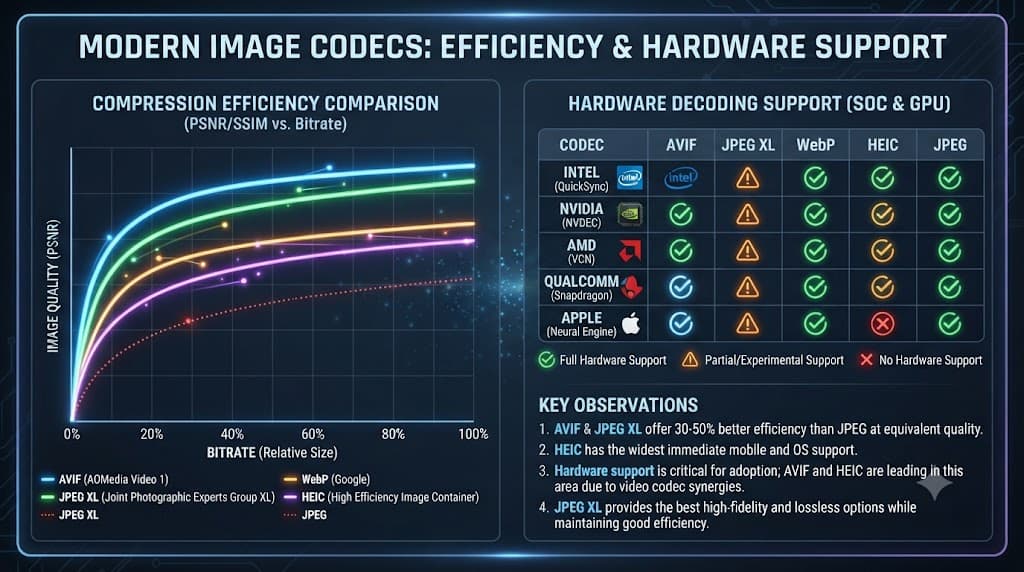
Browser maintainers evaluate codecs through a lens that prioritizes hardware acceleration availability, security vulnerability surface areas, memory safety, and decoding speed on low-end mobile devices. While the format excelled at software-based decoding benchmarks, it lacked the pervasive, dedicated hardware decoding blocks that AV1 and its derivative image profile, AVIF, enjoyed due to joint backing from silicon manufacturers. Deploying a complex software-only codec to billions of mobile handsets introduced unacceptable battery drain and thermal throttling risks during heavy webpage rendering.
[!NOTE] Architectural Note: Unlike video-derived codecs which inherit hardware decoder blocks baked directly into modern smartphone SoCs, still-image formats often rely heavily on CPU execution unless explicit vendor coordination occurs early in the hardware design cycle.
Vendor Politics and the Browser Ecosystem Split
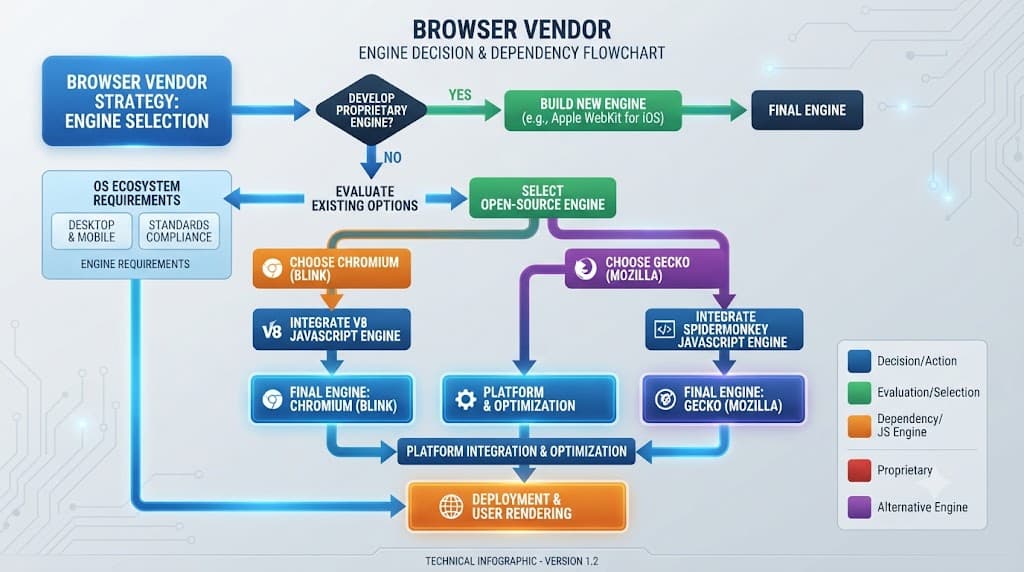
Perhaps the most decisive factor in why did browsers drop jpeg xl support lies within the intricate landscape of vendor politics. The modern web browser ecosystem operates as a delicate geopolitical arena where major stakeholders maintain competing strategic visions for media delivery. Google, wielding immense influence through the Chromium project and the Blink rendering engine, initially experimented with the format, adding flags and test implementations for developers to evaluate.
However, this tentative experimentation abruptly turned into aggressive deprecation. In late 2022, Chromium maintainers removed the experimental implementation entirely, citing insufficient interest from the broader ecosystem, a lack of clear differentiating metrics compared to existing formats, and the ongoing maintenance burden of supporting yet another complex standard. This decision created a stark ecosystem split. While Apple maintained tentative support in Safari for specific professional photography workflows, and niche communities rallied behind the format, the removal from Chromium effectively stunted its path toward becoming a universal web standard. Developers could no longer justify building production pipelines around a format that lacked support in the world's dominant browser engine.
JPEG XL vs. AVIF: The Battle for Next-Gen Dominance
To fully comprehend the trajectory of modern media formats, one must examine the fierce competition between rival standards. The Alliance for Open Media heavily championed AVIF, a format derived directly from the AV1 video codec bitstream. Because hardware manufacturers were already heavily investing in silicon-level decoding blocks for AV1 video streaming across streaming devices, smartphones, and smart TVs, extending those same hardware blocks to decode AVIF images was a logical, highly efficient evolution.
✓ AVIF Advantages
- Widespread hardware decoding support on modern mobile and desktop silicon
- Backed by the Alliance for Open Media and major cloud infrastructure vendors
- Strong native browser integration across Chrome, Firefox, and Safari
- Leverages massive existing investments in AV1 video streaming infrastructure
✕ JPEG XL Advantages
- Lossless transcoding of legacy JPEG files without generational quality loss
- Superior encoding speed and modular feature flexibility for professional editing
- Advanced progressive loading capabilities ideal for low-bandwidth connections
- Rich metadata and high dynamic range preservation out of the box
When conducting a jpeg xl vs avif image format comparison 2026, the technical nuances reveal a divided utility matrix. While JPEG XL often outperforms AVIF in pure encoding speed and offers the unique superpower of lossless JPEG recompression, AVIF won the web standards war through sheer political and infrastructural momentum. Content delivery networks, cloud image manipulation services, and browser vendors could leverage unified AV1/AVIF software libraries and hardware pipelines, rendering the maintenance of a separate, highly complex codebase for JPEG XL redundant and economically unviable.
The Maintenance and Complexity Burden
Software maintainers carry an immense responsibility regarding security, memory safety, and long-term codebase health. Complex image parsing libraries have historically been prime targets for memory corruption vulnerabilities, buffer overflows, and remote code execution exploits. The specification for JPEG XL was notoriously vast, encompassing multiple distinct coding modes, legacy compatibility layers, complex mathematical transforms, and extensive configuration options.
[!WARNING] Security Warning: Large, highly configurable image parsing libraries with deep format specification trees expand the attack surface of browser rendering engines, increasing the long-term risk of critical security CVEs.
For browser engineering teams, adopting such a sprawling standard meant committing permanent engineering resources to auditing, fuzzing, and patching a massive codebase. In an era where browser vendors are aggressively shifting toward memory-safe languages and striving to reduce attack surfaces, introducing a codec with high architectural complexity was a hard sell. The engineering cost of maintaining the implementation simply outweighed the incremental compression gains it offered over existing, hardened alternatives.
Is JPEG XL Dead for Web Development?
For practitioners asking is jpeg xl dead for web development, the short answer is a pragmatic yes. While the format is not dead globally, its permanent relegation outside the critical web path is secure. Web developers building responsive websites, e-commerce platforms, or content-heavy portals cannot rely on a format that lacks universal cross-browser support, particularly given the absence of Chromium backing.
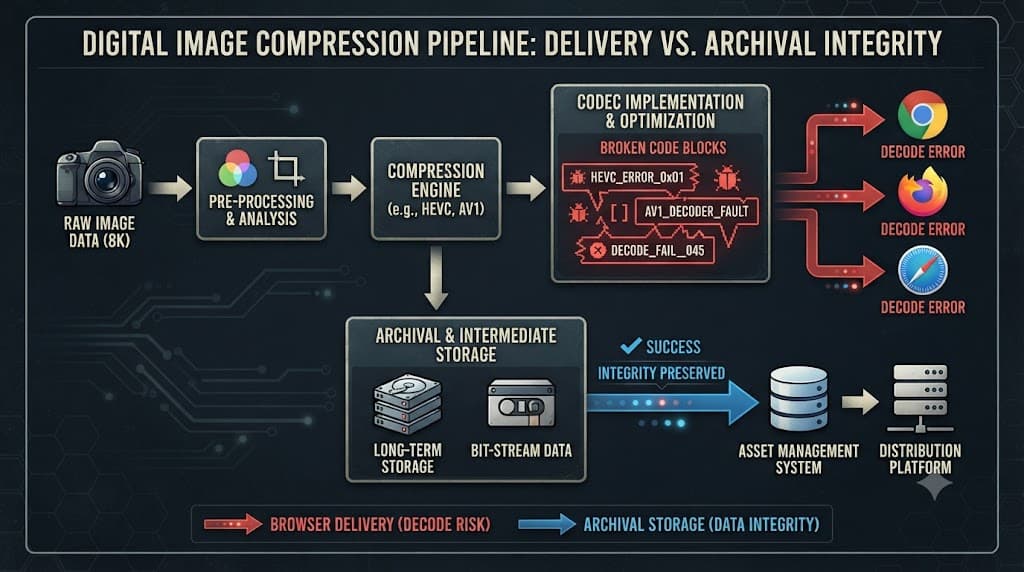
However, declaring the entire format defunct would be a profound misreading of its actual utility. Outside the web browser domain, the format found a robust, thriving home in professional photography, archival preservation, and high-end digital asset management. Cultural heritage institutions, RAW image editors, and professional photographers value its ability to store master-quality images with lossless legacy JPEG containers and advanced color space fidelity. In these closed-loop, native application environments where browser engine restrictions do not apply, it continues to thrive as an exceptional archival standard.
Conclusion: Lessons from a Standardization Failure
Reflecting on the trajectory of this advanced image format yields profound lessons for the software engineering community. The standardization failure underscores the reality that technical perfection alone cannot guarantee adoption in the web ecosystem. Ecosystem alignment, hardware synergy, vendor consensus, and maintenance sustainability are equally vital pillars of modern web standards. While performance engineers may mourn the loss of its mathematical elegance, the web has decisively moved forward, cementing AVIF and WebP as the reigning standards for modern digital asset delivery while relegating JPEG XL to specialized offline workflows.
Topics Covered
Frequently asked questions
Google Chrome removed experimental support for JPEG XL because maintainers cited insufficient ecosystem interest, lack of clear differentiating metrics compared to existing formats, and the ongoing maintenance burden of supporting a complex codebase.
Recommended next