Quick Answer
Resource allocation in container orchestration has traditionally relied on static decisions made at initial scheduling and placement. Once a pod landed on a worker node, changing its CPU or memory requirements meant terminating the existing pod and spinning up a replacement. With the maturation of in-place pod resizing reaching general availability in earlier releases, application developers gained the ability to vertically scale workloads without restarts. However, scaling an active workload often triggers a common bottleneck: what happens when the target worker node lacks sufficient free resources to accommodate the newly requested resource limits?
Enter scheduler preemption for in-place pod resize, introduced as an alpha feature in Kubernetes v1.37. This capability extends the core scheduling loop to evaluate active resize requests against node capacity constraints. When a vertical expansion request cannot be satisfied immediately by the host node, the scheduler can now initiate preemption workflows to free up resources, preventing resize operations from stalling indefinitely. By integrating resize actions into the preemption framework, Kubernetes bridges the gap between dynamic workload optimization and strict node-level capacity boundaries.
Introduction to In-Place Pod Resize and Scheduler Preemption
The historical limitation of Kubernetes resource management forced platform engineers to over-provision clusters or accept application downtime during traffic spikes. If a service required a memory boost, the deployment controller tore down the pod and recreated it, disrupting stateful connections and cache pools. In-place pod resize solved this by allowing cgroups to update resource allocations dynamically. Yet, dynamic updates exposed a new architectural flaw: local node exhaustion. When a pod requested an expanded footprint but the node had no headroom, the resize request sat in a pending state until manual intervention or natural pod churn freed up capacity.
[!NOTE] Architectural Note: In-place resizing updates the pod spec and runtime cgroups simultaneously without altering the underlying container namespaces or restarting the container process.
Kubernetes v1.37 addresses this limitation by introducing scheduler preemption specifically tuned for resize actions. When a node experiences resource pressure during a vertical scaling event, the scheduler evaluates whether lower-priority pods on the same node can be evicted to satisfy the higher-priority resize request. This ensures that critical services can scale up dynamically even on densely packed clusters, maintaining high availability without requiring full pod recreation cycles.
How Scheduler Preemption Works During Pod Resizing
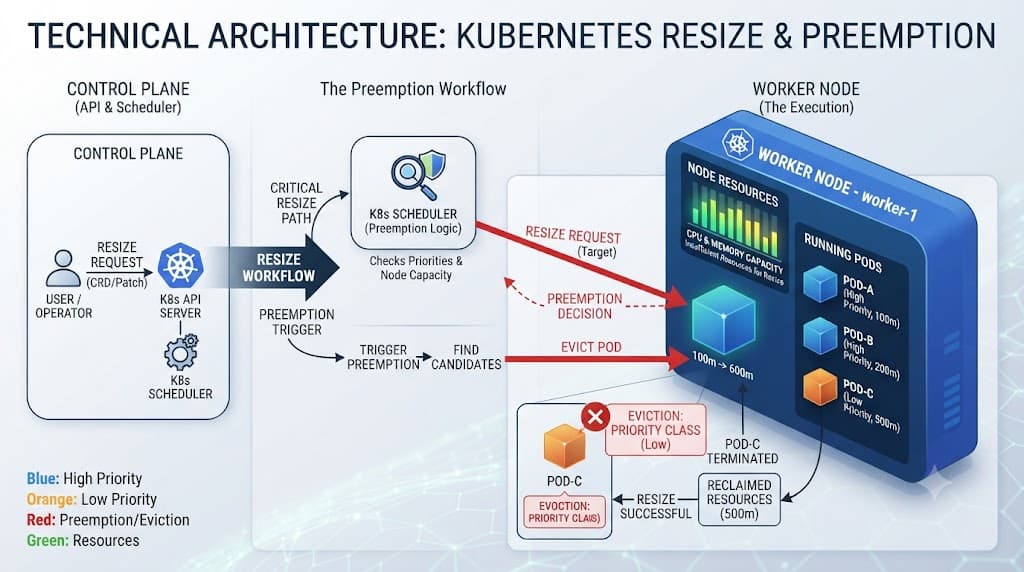
The scheduling cycle for an in-place resize preemption event differs fundamentally from standard pod scheduling. When an API server accepts a resource update for an existing pod, the control plane checks if the host node can accommodate the delta. If the node lacks available CPU or memory, the request engages the scheduler's preemption logic rather than failing outright.
The scheduler inspects the node topology and identifies candidate pods whose priority class is lower than the resizing workload. It calculates the minimum number of evictions required to clear enough headroom for the requested resource delta. Once identified, these candidate pods receive eviction notices, freeing up node capacity. The scheduler then locks the newly available resources for the resizing pod and updates the container runtime configuration.
✓ Key Technical Benefits
- Prevents resize requests from hanging indefinitely due to node saturation
- Maintains workload continuity by avoiding full pod restarts
- Intelligently targets low-priority pods for eviction to preserve critical services
- Streamlines capacity management in densely packed environments
✕ Architectural Challenges
- Alpha feature status introduces potential stability and edge-case risks
- Eviction of lower-priority workloads can create cascading resource churn
- Complex scheduling interactions require careful priority class tuning
- Requires strict monitoring of node memory and CPU allocation limits
Operational Considerations, Limitations, and Best Practices
Deploying scheduler preemption for in-place pod resize in a non-production environment requires careful planning. Because the feature is currently in alpha status, cluster administrators must explicitly enable the relevant feature gates within their control plane configuration. Enabling this without proper priority class hierarchies can lead to unintended evictions of batch jobs or auxiliary daemonsets.
[!WARNING] Warning: Running alpha-stage preemption features in production can lead to unexpected cascading evictions if priority classes are misconfigured across namespaces.
Platform teams should establish strict resource quotas and establish clear priority boundaries before adopting this feature. It is recommended to test resize preemption workloads under simulated memory pressure to observe how the scheduler handles contested node resources. Additionally, monitoring metrics related to scheduler preemption latency and eviction counts will provide vital visibility into cluster stability as workloads scale vertically.