Quick Answer
The landscape of artificial intelligence is shifting rapidly from passive text generation to active, autonomous problem-solving. Developers and automation builders are increasingly looking past standard chatbots in favor of systems capable of executing complex, multi-step workflows independently. Entering this space is the nous research hermes agent, an open-source framework built by Nous Research to bridge the gap between large language models and real-world execution. Whether you are a developer looking to self-host an autonomous assistant or an AI enthusiast wanting to understand how modern agentic pipelines function, this definitive guide covers everything you need to know about the hermes agent ecosystem.
What is Hermes Agent?
At its core, hermes agent is an open-source AI agent framework developed by Nous Research designed to execute multi-step tasks autonomously. Unlike a traditional conversational model that simply responds to a single prompt, an open source AI agent like Hermes is engineered to reason through a user objective, break it down into sequential actions, utilize external tools, maintain persistent memory, and adapt its approach based on intermediate feedback.
The project stems from Nous Research's extensive work on fine-tuning state-of-the-art open-source language models, particularly the Hermes model series. By combining these advanced reasoning engines with robust tool-use capabilities, the hermes agent ai framework provides users with a reliable foundation for automation. Instead of treating the language model as a closed-box oracle, Hermes treats it as the cognitive core of a dynamic system that can interact with APIs, databases, filesystems, and specialized development environments.
For self-hosters and developers, the arrival of the nous research AI agent represents a major step forward. It offers a transparent, hackable alternative to proprietary agent platforms, ensuring that users retain full control over their data, model selection, and execution context. Throughout this guide, we will unpack how the system operates under the hood, how to install and configure it, and how it compares to other frameworks in the modern AI ecosystem.
How Hermes Agent Works and Core Architecture
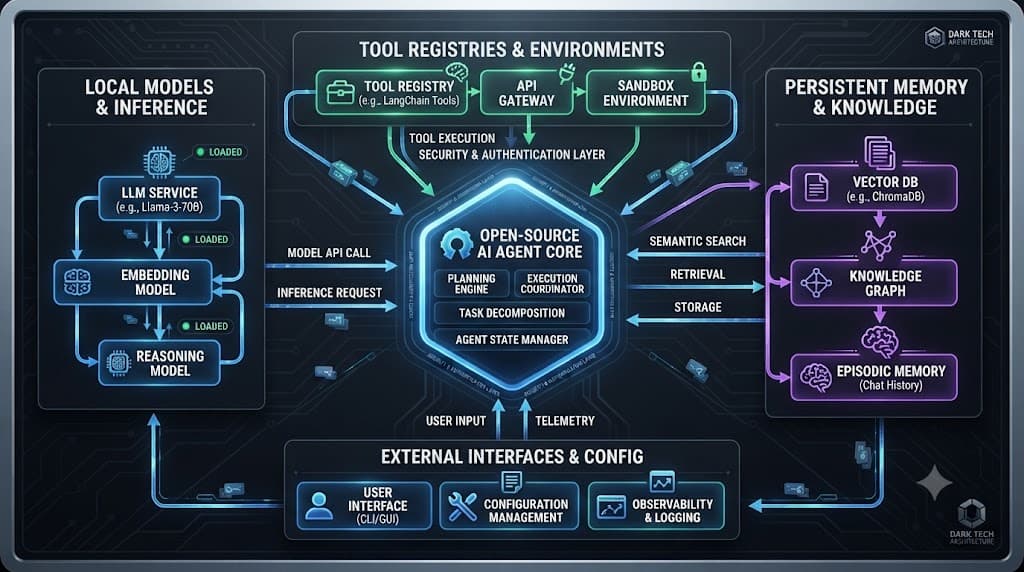
Understanding how the autonomous AI agent operates requires looking beneath its user interface into its modular runtime architecture. At its heart, Hermes relies on an iterative execution loop often referred to as the perceive-reason-act cycle. When a user submits an objective, the core LLM analyzes the prompt, evaluates available tools, and generates a structured plan.
As illustrated in the architecture flow above, the system does not simply guess an answer; it tests hypotheses and observes the results of its actions. If a tool call fails or returns an unexpected error, the hermes ai agent captures that error message as an observation, feeds it back into the context window, and prompts the model to correct its course dynamically.
The architecture is heavily decoupled, separating the cognitive reasoning layer from the execution and integration layers. This modularity ensures that developers can swap out components—such as replacing local model backends with cloud endpoints or adding custom tools—without rewriting the core agent loop. Memory management is handled via hierarchical context stores, allowing the agent to retain short-term conversational context while pulling long-term knowledge from vector databases or local files when necessary.
[!NOTE] Architectural Note: The strength of the Hermes runtime lies in its strict adherence to structured tool-calling schemas, which minimizes hallucination rates and ensures that parameters passed to external APIs match required data types.
Main Features, Models, and Tooling Ecosystem
The feature set of the hermes agent extends far beyond basic chat completion, offering a rich environment for building sophisticated automation pipelines. One of its standout attributes is its model-agnostic flexibility. While optimized for Nous Research's custom-tuned models, the framework seamlessly integrates with a wide variety of model providers, including local execution runtimes like Ollama and cloud-based routing aggregators like OpenRouter.
When it comes to tooling, the hermes agent ai supports a modular registry of functions that the model can invoke dynamically. These range from simple filesystem readers and web scrapers to complex execution environments capable of running shell commands, executing Python scripts, and querying SQL databases. Furthermore, the inclusion of Model Context Protocol (MCP) support allows the agent to connect instantly with standardized data sources and external developer tools without custom boilerplate code.
Memory and skill persistence round out the ecosystem. The agent can save learned procedures or user preferences into local skill files, enabling it to recall specialized workflows across sessions. This combination of flexible models, robust tooling, and persistent memory transforms the nous research hermes agent into a comprehensive workspace assistant rather than a single-purpose utility.
Installation and Configuration Overview
See also: Docker Sandboxes
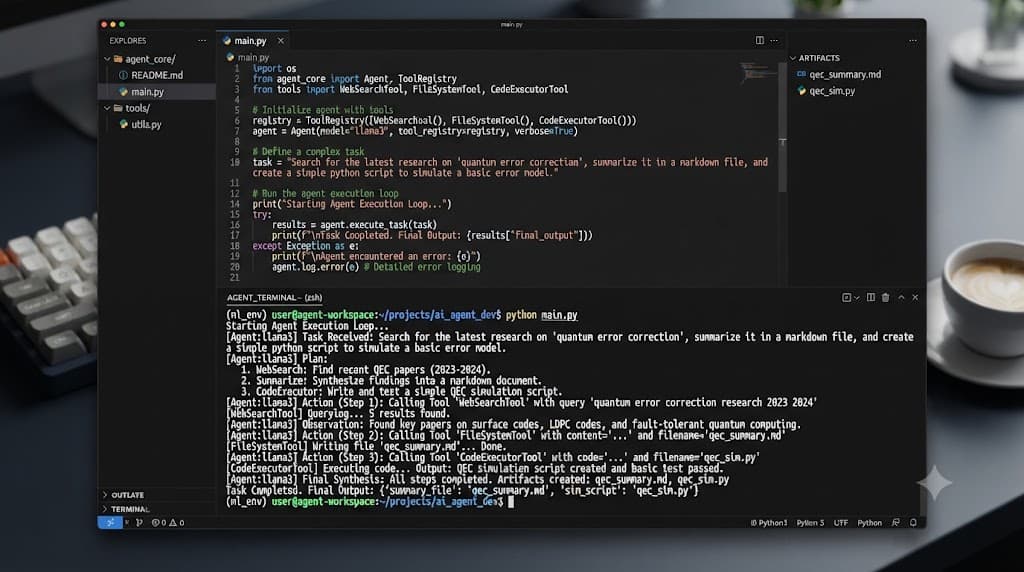
Deploying the hermes agent locally is designed to be straightforward for developers and self-hosters familiar with Python environments and command-line interfaces. To get started, ensure you have Python 3.10 or higher installed on your system along with Git.
First, clone the official repository and navigate into the project directory:
git clone https://github.com/NousResearch/hermes-agent.git
cd hermes-agent
Next, set up a virtual environment and install the required dependencies using pip or your preferred package manager:
python3 -m venv venv
source venv/bin/activate
pip install -r requirements.txt
Once installed, you must configure your environment variables. Copy the template configuration file and populate your API keys (such as OpenRouter or local Ollama endpoints):
cp .env.example .env
# Edit .env with your preferred model provider keys and settings
[!TIP]
Pro Tip: For privacy-focused setups, configure your .env file to point directly to a local Ollama instance running the latest Hermes weights, ensuring zero data leaves your local machine during agent execution.
After configuration, you can launch the agent CLI or initialize the interactive session using the primary execution script:
python main.py --interactive
Hermes Agent vs Other Frameworks
To fully appreciate where the nous research AI agent fits in the broader landscape, it is helpful to compare it directly against alternative ecosystems like OpenClaw and specialized coding agents. While many frameworks exist to solve narrow automation tasks, Hermes aims to provide a generalized, highly extensible reasoning engine.
✓ Advantages of Hermes Agent
- Deep integration with state-of-the-art open-source fine-tuned models
- Model-agnostic support for both local Ollama and cloud OpenRouter endpoints
- Extensible tool registry with native Model Context Protocol support
- Full data sovereignty and transparent self-hosting capabilities
✕ Comparative Considerations
- Requires manual configuration and environment setup compared to turnkey SaaS tools
- General-purpose nature means niche coding agents may have deeper IDE-specific integrations out of the box
- Self-hosted deployments require managing your own hardware and model inference resources
Unlike rigid coding assistants locked into specific IDE plugins, the open source AI agent approach championed by Nous Research allows builders to orchestrate workflows across entirely disparate domains—such as combining database queries, web research, and file generation in a single unified session.
Practical Use Cases and Automation Examples
The true power of the hermes agent ai becomes apparent when applied to real-world automation scenarios. Because the agent can execute multi-step plans and utilize external tools, automation builders use it to streamline complex, repetitive workflows that would normally require manual intervention.
One common use case is automated market and competitor research. A developer can instruct the agent to monitor specific RSS feeds, scrape competitor pricing pages using web tools, summarize the findings into structured JSON, and append the results directly to a local database or markdown report. Because the hermes agent maintains conversational state and handles errors gracefully, if a target website returns a 403 error or changes its layout, the agent can alter its scraping strategy on the fly.
Another powerful application is local DevOps automation and log analysis. Engineers configure the autonomous AI agent to scan local system logs when an alert triggers, isolate error stack traces, search internal documentation or GitHub issues for matching signatures, and draft a remediation script. By executing the script in a sandboxed environment and verifying the output, the agent significantly reduces incident response times while keeping sensitive infrastructure data secure behind local firewalls.
Security Considerations, Risks, and Common Mistakes
Deploying any powerful open source AI agent requires a careful approach to security and risk management. Because the nous research hermes agent possesses the capability to execute shell commands, read and write files, and interact with external APIs, giving it unfettered access to production environments without guardrails is a critical mistake.
[!WARNING] Warning: Never grant an autonomous agent unrestricted root access to production servers or expose unauthenticated tool endpoints to the public internet. Always run agent execution loops inside isolated containers or sandboxed environments.
Users often fall into several common traps when first working with the framework:
- Treating it as a simple chatbot: Expecting single-turn conversational answers rather than leveraging its multi-step planning and tool-execution loops.
- Confusing model providers with the agent: Assuming that changing a model endpoint alters the agent's core reasoning framework or memory management layers.
- Neglecting security boundaries: Failing to restrict filesystem and shell tool permissions, leading to potential unintended file modifications or data leaks.
By clearly distinguishing between documented core capabilities and experimental community extensions, builders can harness the full potential of the hermes agent while maintaining robust system security and operational stability.