Quick Answer
Stateful workloads in containerized ecosystems have historically faced challenges when orchestrating efficient backup and disaster recovery operations. Traditional snapshot mechanisms often require scanning entire volumes to detect changes, introducing substantial storage and network overhead. The introduction of the Changed Block Tracking API addresses this operational friction directly, providing a standardized mechanism to query modified storage blocks across persistent volumes.
Originally launched in an Alpha state in September 2025, the feature allowed early adopters and storage vendors to experiment with incremental backups. With the March 2026 v1.0.0 release of the external-snapshot-metadata project, the feature officially moved to Beta. This milestone marks a critical turning point for platform engineers who manage data protection at scale, establishing a robust foundation for production-grade Kubernetes backup architectures.
Introduction to Kubernetes Changed Block Tracking
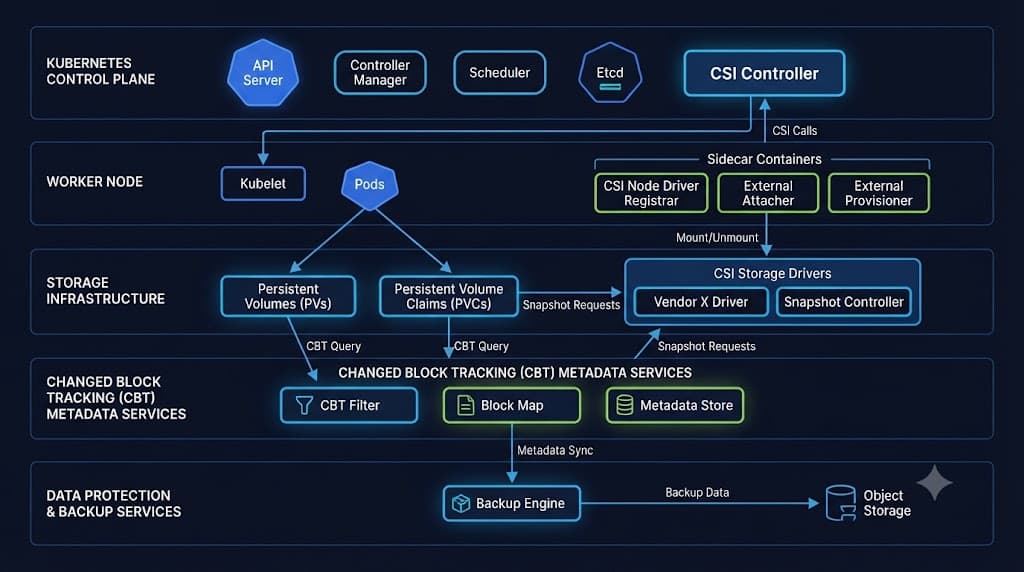
Changed Block Tracking (CBT) fundamentally transforms how backup applications interact with persistent storage in cloud-native environments. Instead of reading an entire volume block-by-block to determine what has changed since the last backup cycle, a CBT-enabled system queries a metadata service to retrieve a precise list of modified byte ranges. This capability drastically reduces backup windows, minimizes network bandwidth consumption, and lowers storage I/O overhead during snapshot operations.
During its initial Alpha phase, the API established proof-of-concept communication pathways between backup controllers and storage plugins. However, it lacked the stability guarantees and rigorous interface definitions required for enterprise adoption. The progression to Beta via the external-snapshot-metadata project standardizes these interactions, ensuring that storage vendors can implement consistent APIs without fearing breaking schema changes in minor patch releases.
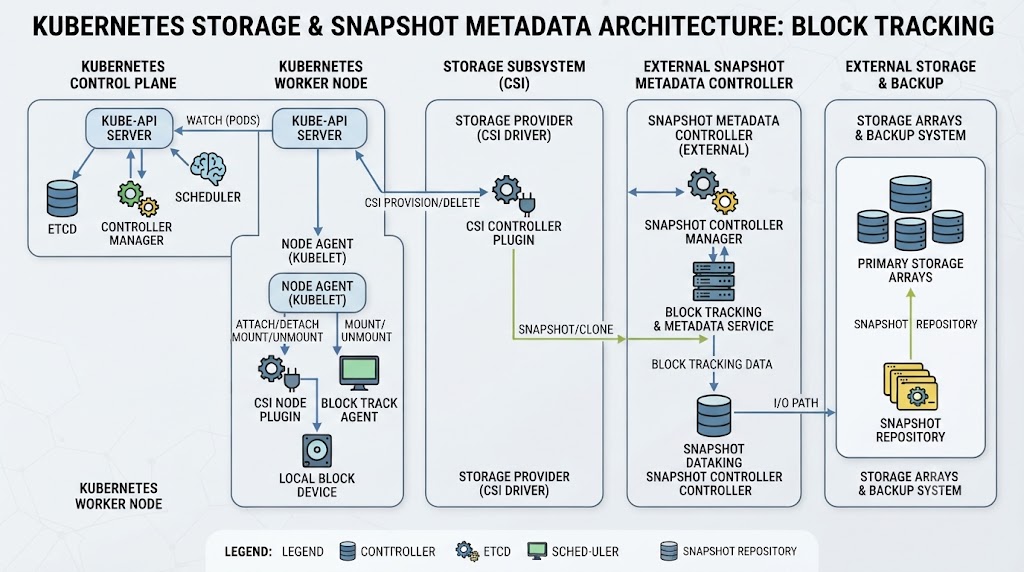
[!NOTE] Architectural Background: The external-snapshot-metadata project decouples block-tracking queries from the core Kubernetes volume snapshot controller, allowing storage vendors to implement high-performance metadata sidecars.
How the CBT API Works for CSI Drivers
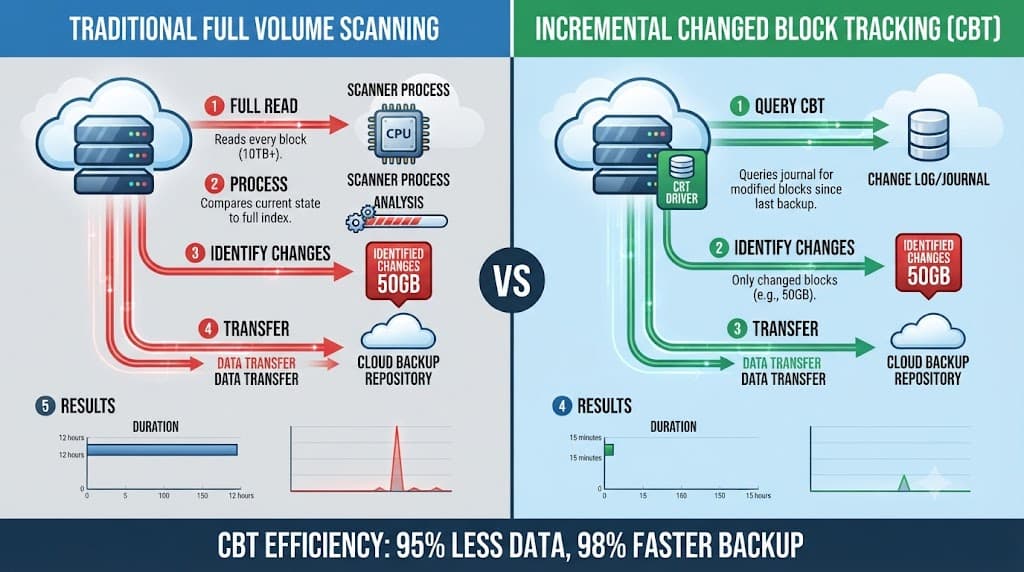
Container Storage Interface (CSI) drivers serve as the bridge between orchestrator-level requests and underlying storage arrays. When a backup utility requests an incremental backup, it interacts with the CSI driver to query changes between two distinct volume snapshots. The workflow relies on standardized Custom Resource Definitions (CRDs) and gRPC endpoints exposed by the storage plugin.
To execute this lookup, the backup controller submits a request specifying the base snapshot and the target snapshot. The CSI driver communicates with the underlying storage controller, which maintains allocation maps or write-logging structures. Once the changed blocks are identified, the driver translates the physical or logical block addresses into a standardized map returned to the caller. The backup engine then reads only those specific blocks, streaming a highly optimized incremental payload to the target backup repository.
Key Differences Between Alpha and Beta Implementations
Transitioning from Alpha to Beta brought substantial architectural hardening, API schema cleanup, and operational reliability enhancements. While the Alpha release validated the core concept, it suffered from tight coupling and limited error-handling capabilities when storage controllers encountered temporary connection drops.
The Beta implementation introduces stricter API contracts, improved garbage collection for abandoned snapshot metadata objects, and refined RBAC (Role-Based Access Control) permissions. Furthermore, the external-snapshot-metadata v1.0.0 release provides better diagnostic tooling and logging, allowing operators to debug failed block queries without wading through raw storage driver traces.
✓ Beta Improvements
- Stable API schemas preventing sudden breaking changes
- Enhanced error recovery during network partitions
- Standardized CRDs via external-snapshot-metadata v1.0.0
- Improved garbage collection for stale metadata
✕ Alpha Limitations
- Brittle communication pathways prone to hanging
- Inconsistent error codes across storage providers
- Lack of robust diagnostic tooling or metrics
- Manual cleanup required for abandoned metadata objects
Benefits and Limitations of the Beta Release
The adoption of the Beta-stage CBT API yields immediate operational advantages for platform engineering teams. Backup windows shrink from hours to minutes, compute resource consumption drops significantly, and storage infrastructure experiences lower contention during peak operational hours. These improvements make continuous data protection viable even for massive stateful workloads.
However, administrators must remain aware of current architectural limitations. The feature relies entirely on whether a specific CSI driver implements the required metadata gRPC endpoints; legacy or proprietary storage drivers lacking this support cannot utilize the API. Additionally, managing very large snapshot chains requires careful retention policy configuration to prevent excessive metadata tracking overhead on the storage array.
[!WARNING] Production Caution: Ensure your storage vendor explicitly certifies their CSI driver for the external-snapshot-metadata v1.0.0 specification before enabling CBT-based backups in production clusters.