Quick Answer
Kubernetes v1.37 marks a major milestone for resource management with the graduation of Memory QoS to Beta, making it enabled by default across eligible clusters. For platform engineers and cluster administrators, this transition changes how container memory is governed under heavy workloads, leveraging advanced Linux kernel capabilities to maintain cluster stability and performance.
Introduction to Kubernetes v1.37 and Memory QoS
Resource governance in distributed systems has always been a tightrope walk between high utilization and absolute stability. In previous versions, container memory allocation relied heavily on traditional limits that could result in abrupt OOM (Out of Memory) kills when workloads spiked unexpectedly. With Kubernetes v1.37, the graduation of Memory QoS to Beta addresses these historical limitations by introducing smarter kernel-level guardrails that are active right out of the box.
Previously an opt-in alpha feature, Memory QoS changes the paradigm by utilizing underlying Linux control group primitives to ensure that container memory pressure is handled gracefully rather than destructively. Because it is now enabled by default, administrators upgrading to Kubernetes v1.37 will immediately benefit from refined memory protection mechanisms without needing manual configuration flags in every pod specification.
[!NOTE] Architectural Note: Memory QoS does not replace resource requests and limits. Instead, it complements them by instructing the Linux kernel on how to prioritize memory reclaim and distribution among competing container hierarchies.
How Memory QoS Works with Linux cgroup v2
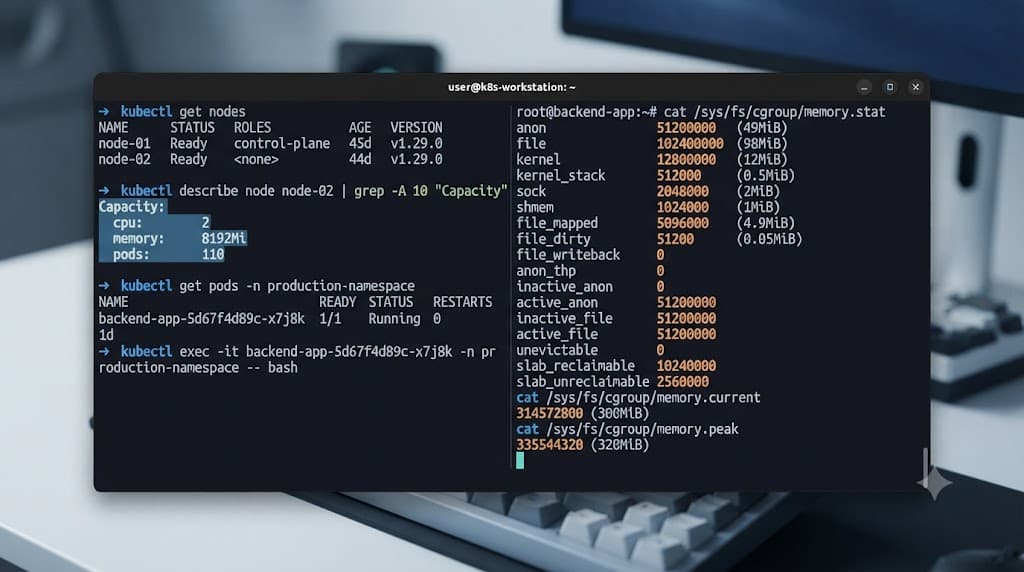
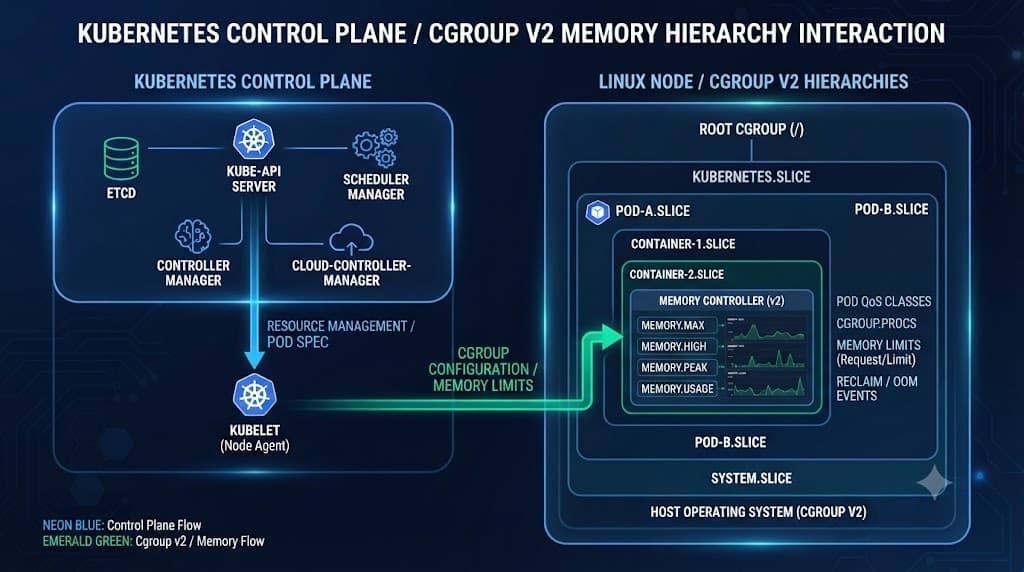
The foundation of Memory QoS rests firmly on modern Linux primitives, specifically requiring nodes running cgroup v2. Unlike the legacy cgroup v1 architecture, cgroup v2 provides a unified hierarchy that allows the kernel to understand resource relationships holistically. Kubernetes v1.37 harnesses this unified structure to map container requests and limits directly to cgroup v2 memory controller attributes like memory.min, memory.low, and memory.high.
When a pod defines a memory request, Memory QoS leverages memory.min or memory.low to establish a protected memory floor. If the node experiences severe memory pressure, the Linux kernel will protect these designated memory zones from being reclaimed, safeguarding critical application states from sudden eviction. Conversely, limits map to parameters like memory.high to trigger proactive asynchronous page reclamation before hitting hard boundaries.
[!TIP] Pro Tip: Ensure your underlying Linux nodes are running kernel versions fully optimized for cgroup v2 feature sets to unlock the full spectrum of Memory QoS capabilities in Kubernetes v1.37.
Impact, Benefits, and Operational Best Practices
With Memory QoS enabled by default in Kubernetes v1.37, the operational dynamics of managing multi-tenant clusters shift significantly. Workloads are granted better isolation, reducing noisy-neighbor phenomena where a single misbehaving container starves adjacent pods of critical memory resources. However, platform teams must still adopt rigorous monitoring practices to track how kernel reclaim mechanisms interact with their specific application memory footprints.
✓ Advantages
- Enhanced protection for guaranteed workloads via memory floors
- Proactive kernel reclamation reducing abrupt OOM kills
- Automatic activation out of the box in Kubernetes v1.37
✕ Limitations
- Strict dependency on modern Linux distributions with cgroup v2
- Requires careful tuning of container memory requests
- Potential behavior shifts for legacy workloads upon upgrade
To ensure a smooth transition, administrators should audit existing pod definitions, verifying that memory requests accurately reflect realistic baseline consumption rather than arbitrary guesses. Because Memory QoS relies heavily on these requests to configure kernel protection tiers, poorly sized requests can lead to unexpected resource hoarding or suboptimal reclamation behavior.
[!WARNING] Warning: Do not assume legacy monitoring tools will instantly report cgroup v2 kernel metrics correctly. Update your telemetry stack to observe modern memory controller statistics across your Kubernetes v1.37 fleet.