Quick Answer
Modern generative AI applications operate at a scale that fundamentally breaks traditional cloud-native architectural patterns. When servicing an active user base numbering in the billions while sustaining a throughput of 22 million requests per second (RPS) at the database layer, standard relational designs or simple horizontal sharding strategies collapse under their own weight. The engineering challenge is no longer merely about handling high query volumes; it is about maintaining deterministic tail latencies, executing complex vector similarity searches alongside transactional state mutations, and ensuring that a failure in one region or tenant boundary never cascades into a global outage. OpenAI Habitat was engineered specifically to solve these constraints, acting as the high-availability backbone for mission-critical conversational AI workloads.
To understand the magnitude of this engineering feat, consider the data access patterns of large language model (LLM) platforms. Every token generated, every conversation history retrieved, and every preference vector calculated requires sub-millisecond round trips across distributed storage engines. Traditional monolithic database architectures suffer from connection starvation, lock contention on hot user accounts, and memory exhaustion when loading high-dimensional index structures into RAM. OpenAI Habitat bypasses these traditional bottlenecks by rethinking the entire database topology from the storage engine up to the global routing mesh. This article provides a comprehensive structural teardown of the OpenAI Habitat storage architecture, examining how isolation, cell-based topologies, and multi-model database engines work in tandem to sustain extreme web-scale workloads.
Introduction to OpenAI Habitat and Extreme Scale Requirements
The architectural genesis of OpenAI Habitat stems from the realization that centralized distributed databases hit a hard scaling ceiling when subjected to the bursty, highly concurrent nature of generative AI traffic. At 1 billion active users, standard user profile tables, conversational metadata logs, and real-time session states generate petabytes of churn daily. More critically, the variance in user activity creates massive hot spots. A single viral prompt or sudden global surge can direct millions of concurrent requests toward specific organizational tenants or thread identifiers. If the storage layer relies on a shared-everything model, these hot spots saturate network interfaces, exhaust connection pools, and elevate p99 latencies globally.
[!NOTE] Architectural Note: OpenAI Habitat approaches scalability not by building larger single-node clusters, but by enforcing strict resource bounding and blast-radius containment through independent deployment units.
To mitigate these risks, the OpenAI Habitat storage architecture decouples stateless compute workers from stateful persistence layers while introducing strict physical boundaries. Every piece of data—from user credentials and chat logs to cached attention vectors—must be categorized by its access frequency and consistency requirements. Low-latency conversational loops require immediate read-after-write consistency, whereas analytical logging and vector embedding training can tolerate eventual consistency models. Balancing these competing demands across 22 million requests per second requires a meticulous division of labor between high-throughput relational engines and specialized vector storage substrates. The following sections will dismantle how Habitat achieves this balance without compromising data integrity or system resilience.
Core Principles of the OpenAI Habitat Cell Model
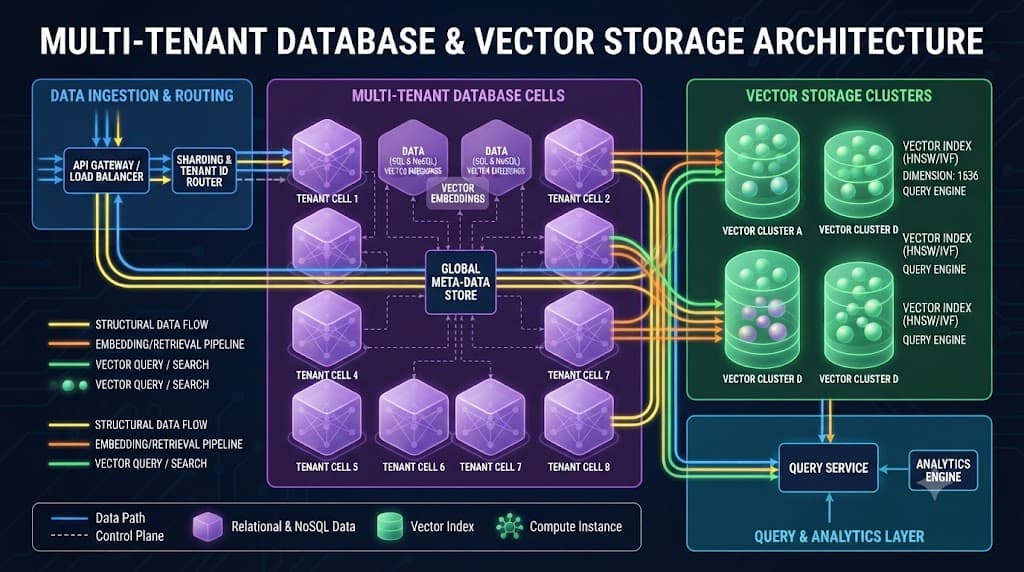
The cornerstone of the OpenAI Habitat storage architecture is the cell model—a design pattern that partitions the global infrastructure into self-contained, highly deterministic units known as "cells." Each cell functions as an independent mini-deployment containing its own compute workers, caching layers, relational database instances, and vector storage engines. By bounding the maximum number of users and transactions a single cell can service, Habitat ensures that any hardware failure, software bug, or traffic spike remains strictly localized to that specific cell.
Within the OpenAI Habitat cell model, cross-cell communication is heavily restricted. Tenants are deterministically assigned to a specific cell upon account creation or migration, ensuring that user session data rarely traverses cross-region boundaries during normal operational states. This isolation eliminates the distributed lock manager (DLM) bottlenecks that typically plague large-scale relational clusters. If a single cell experiences hardware degradation or network partition, only the fraction of users mapped to that cell are impacted. Automated control planes can instantly spin up a replacement cell and replay transaction logs from durable object storage, reducing mean time to recovery (MTTR) from hours to seconds.
Furthermore, the cell model drastically simplifies capacity planning and horizontal scaling. Engineers do not need to forecast global resource allocation or manage monolithic database shards that span thousands of nodes. Instead, scaling out simply involves provisioning identical new cells and updating the global routing directory. This predictable, repeatable topology is essential for maintaining strict latency Service Level Agreements (SLAs) across massive fleets of hardware.
High-Throughput Relational and Vector Storage Layer
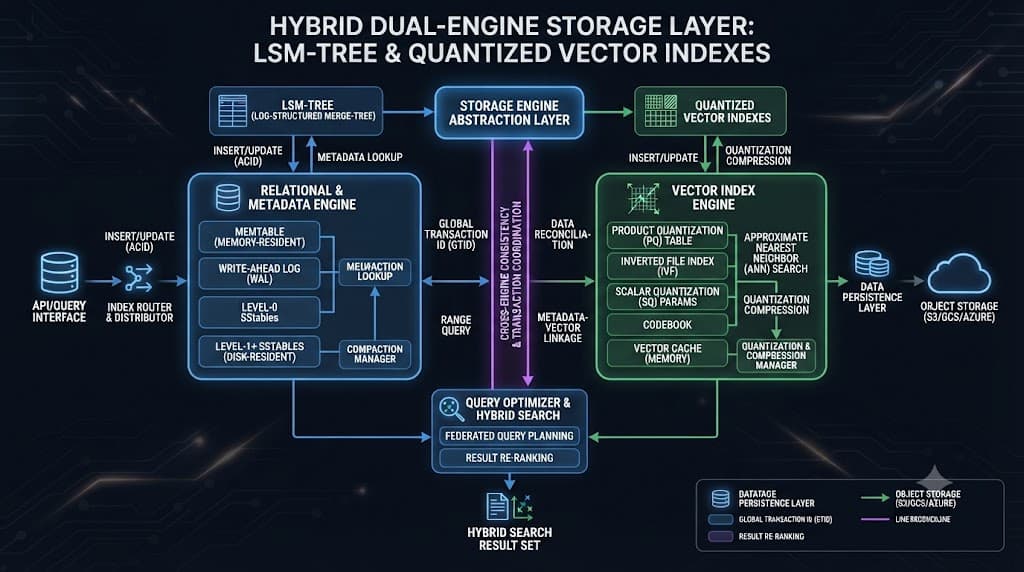
LLM applications require a hybrid data storage paradigm that traditional database engines struggle to provide natively. On one hand, user management, billing, permissions, and session threads demand strict ACID guarantees and relational integrity. On the other hand, semantic caching, retrieval-augmented generation (RAG) pipelines, and context window management require lightning-fast vector similarity searches across millions of high-dimensional embeddings. OpenAI Habitat addresses this challenge by deploying a dual-engine storage layer within each cell, tightly coupling a distributed relational database with a high-throughput vector storage subsystem.
The relational metadata management tier handles transactional state updates using optimized LSM-tree and B-tree hybrid storage engines that minimize write amplification on NVMe drives. Concurrently, the vector storage engine operates as an in-memory-first index structure utilizing quantized vector representations to compress embedding footprints without sacrificing recall accuracy. By co-locating the relational session metadata and the associated vector indices on the same physical node boundaries within the cell, Habitat eliminates cross-network chatter during context retrieval operations.
✓ Relational Metadata Strengths
- Guaranteed ACID compliance for billing and auth states
- Optimized for low-latency point lookups and range scans
- Predictable write-ahead logging (WAL) for durability
⚡ Vector Engine Strengths
- Sub-10ms approximate nearest neighbor (ANN) searches
- Product quantization for high-density memory reduction
- Seamless integration with LLM embedding pipelines
Maintaining performance under 22 million requests per second requires aggressive memory caching and zero-copy data serialization between the application runtime and the storage drivers. Habitat utilizes custom memory allocators to prevent fragmentation caused by fluctuating JSON payloads and large prompt contexts, ensuring that garbage collection pauses never breach the strict tail-latency thresholds demanded by real-time conversational interfaces.
Data Ingestion, Partitioning, and Routing at 22M RPS
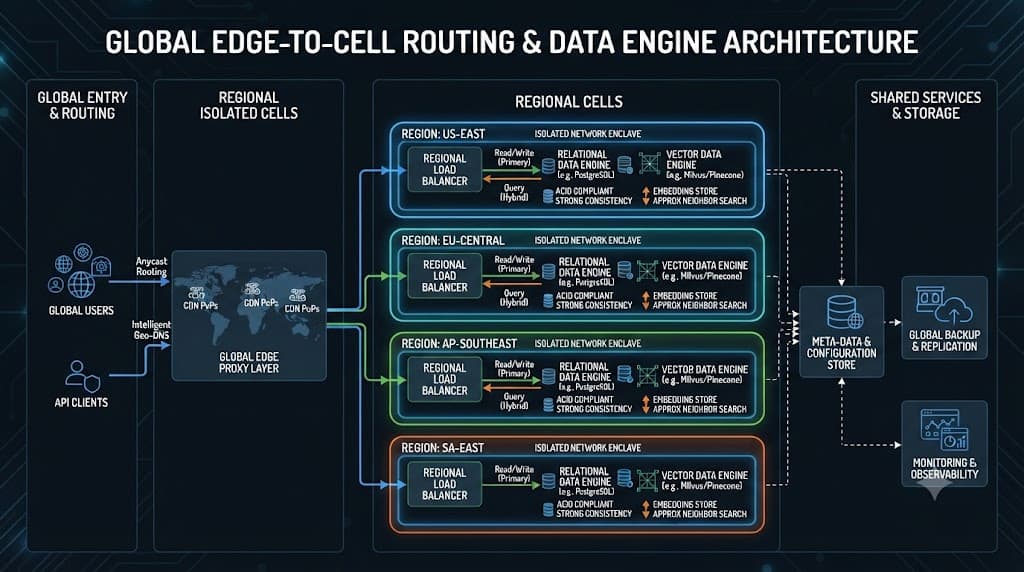
Routing 22 million requests per second to the correct database partition without introducing a central bottleneck requires an intelligent, multi-tiered routing mesh. In the OpenAI Habitat architecture, ingestion begins at edge proxy layers that terminate TLS connections and perform initial request validation. These edge nodes interface with a distributed global routing directory that maps user identifiers and session tokens to specific database cells and internal sharding keys.
To prevent hot-spotting—where a single user or organization floods a database partition—Habitat implements consistent hashing algorithms with virtual nodes combined with dynamic load-shedding policies. If an incoming write or read stream exceeds predefined throttling thresholds for a specific partition, the routing mesh automatically applies adaptive backpressure or routes read traffic to localized read replicas. Furthermore, write operations are batched at the proxy layer using asynchronous ring buffers, transforming thousands of micro-transactions into consolidated bulk writes that maximize IOPS efficiency on underlying NVMe storage arrays.
[!WARNING] Warning: Naive hash-based partitioning based solely on user IDs will inevitably cause severe hot-spotting in conversational platforms due to power-law usage distributions among active users.
To neutralize this, Habitat introduces composite hashing keys that incorporate time-bucketed window suffixes alongside tenant identifiers. This ensures that even high-frequency accounts have their write paths distributed across multiple physical disk segments over time, preventing single-file lock contention and ensuring linear write scalability across the entire cluster.
Replication, Consistency Models, and Fault Tolerance
Achieving high availability across global deployments while sustaining massive request throughput necessitates pragmatic trade-offs in consistency models. OpenAI Habitat rejects rigid, synchronous multi-region locking in favor of localized synchronous replication coupled with asynchronous cross-region synchronization. Within a single cell, data durability is guaranteed via distributed consensus protocols (such as optimized Raft variants) operating across multiple availability zones (AZs), ensuring zero data loss in the event of an entire data center failure.
However, across geographic regions, Habitat adopts tunable consistency. Conversational metadata critical to session continuity utilizes quorum reads and writes within the local region, while background telemetry, analytics, and non-blocking embedding updates synchronize asynchronously. This hybrid approach guarantees that user-facing conversational loops remain lightning-fast and unaffected by trans-oceanic network jitter or submarine cable cuts.
To handle network partitions (split-brain scenarios), Habitat cells rely on external witness nodes deployed in neutral fault domains. If a minority partition loses connectivity with the majority quorum, it immediately revokes its write privileges and enters read-only mode until cluster state reconciliation completes. This rigorous adherence to partition tolerance (the 'P' in the CAP theorem) prevents silent data corruption and ensures that conflicting state mutations are never written concurrently to divergent storage tiers.
Real-World Engineering Challenges and Failure Modes
Operating infrastructure at the scale of OpenAI Habitat exposes subtle, catastrophic failure modes that do not manifest in standard enterprise environments. One of the most prevalent challenges is tail latency amplification caused by background compaction storms in LSM-tree storage engines. When multiple database partitions simultaneously trigger garbage collection and index compaction, disk IOPS saturation causes p99 latencies to spike from 10 milliseconds to several seconds. Habitat combats this by implementing token-bucket IO rate limiters on background maintenance tasks, ensuring that user-facing foreground traffic always receives absolute priority for disk and CPU cycles.
Another critical engineering hurdle is memory fragmentation in vector storage indexes. As millions of chat sessions open and close, dynamic index restructuring can leave holes in memory pools, eventually triggering Out-Of-Memory (OOM) killer events despite sufficient total system RAM. Habitat resolves this by utilizing fixed-size memory arenas and custom slab allocators for vector quantization tables, completely eliminating dynamic heap fragmentation during runtime operations.
Telemetry and observability at 22M RPS also present a paradox: collecting granular metrics generates more data volume than the storage system itself can process. Habitat addresses this through hierarchical metric aggregation, performing local statistical sampling and anomaly detection directly on edge nodes before streaming compressed telemetry summaries to centralized monitoring clusters. This distributed tracing approach allows reliability engineers to isolate cascading failure roots in real-time without drowning in raw log noise.
Conclusion and Future Blueprints for LLM Storage Systems
The architectural evolution exemplified by OpenAI Habitat proves that scaling modern generative AI applications past 1 billion active users and 22 million requests per second requires a departure from traditional monolithic database thinking. By combining the rigorous blast-radius isolation of the cell model, the dual-engine synergy of relational metadata and vector storage, and intelligent multi-tiered routing, infrastructure engineers can build systems that are both hyper-scalable and deterministically resilient. As LLM context windows expand and multi-modal interactions become ubiquitous, the storage patterns pioneered by Habitat will serve as the foundational blueprint for the next generation of distributed systems engineering.
Adopting these paradigms does not require an immediate rewrite of existing enterprise stacks, but it does demand a strategic shift toward decentralization, tenant isolation, and hybrid data modeling. By treating storage cells as independent, disposable units and embracing tunable consistency for high-throughput workloads, engineering teams can future-proof their applications against the relentless demands of hyperscale AI.
Topics Covered
Frequently asked questions
The OpenAI Habitat cell model is an architectural pattern that divides global infrastructure into self-contained, independent deployment units called cells. Each cell contains its own compute, caching, relational, and vector storage engines. It is used to bound blast radii, eliminate cascading failures, and guarantee predictable tail latencies.
Recommended next