Quick Answer
AI/ML and complex batch workloads continue to push the boundaries of modern container orchestration. As clusters scale to accommodate large language model training runs and distributed data processing pipelines, traditional bin-packing schedulers often fall short of meeting complex topological and throughput requirements. Following foundational workload-centric enhancements introduced in previous releases, Kubernetes v1.37 delivers the next major milestone in workload-aware scheduling, offering finer-grained resource control, improved job coordination, and deeper integration with heterogeneous hardware accelerators.
Introduction to Workload-Aware Scheduling in Kubernetes v1.37
The fundamental challenge in modern cloud-native environments is bridging the gap between high-level workload semantics and low-level node resource allocation. Historically, the default Kubernetes scheduler evaluated pods largely in isolation or relied on basic pod affinity and anti-affinity rules. While sufficient for stateless microservices, this approach frequently leads to resource fragmentation, pod starvation, and inefficient hardware utilization when orchestrating multi-node distributed training jobs or massive batch processing pipelines.
Kubernetes v1.37 directly addresses these limitations by evolving the scheduling framework to natively understand workload-level intent. By shifting focus from individual container specs to holistic workload groupings, the control plane can now coordinate scheduling decisions across distributed pods simultaneously. This evolution reduces job completion times, minimizes scheduling deadlocks, and ensures that expensive hardware accelerators like GPUs and TPUs are fully saturated without unnecessary queuing overhead.
[!NOTE] Architectural Background: Workload-aware scheduling builds upon the generalized scheduler framework (Scheduling Framework v2) introduced in earlier minor releases, expanding plugin extension points to intercept and manipulate scheduling queues based on custom batch criteria.
Core Enhancements and Architectural Changes
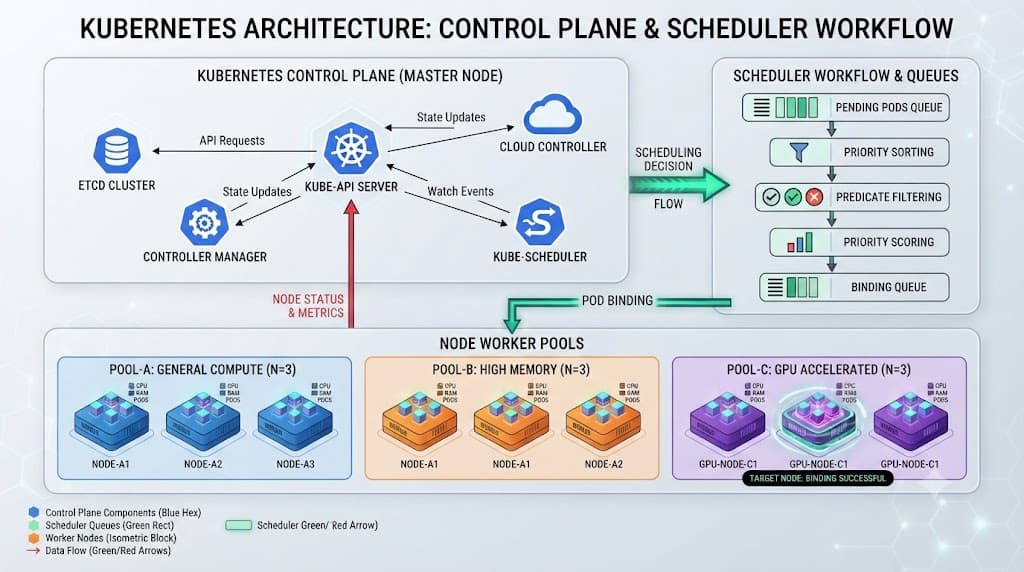
At the heart of Kubernetes v1.37 are several key architectural adjustments within the kube-scheduler and related control plane components. These improvements focus on extensibility, performance at scale, and native support for gang-scheduling and quota management semantics without requiring out-of-tree controllers for basic batch execution.
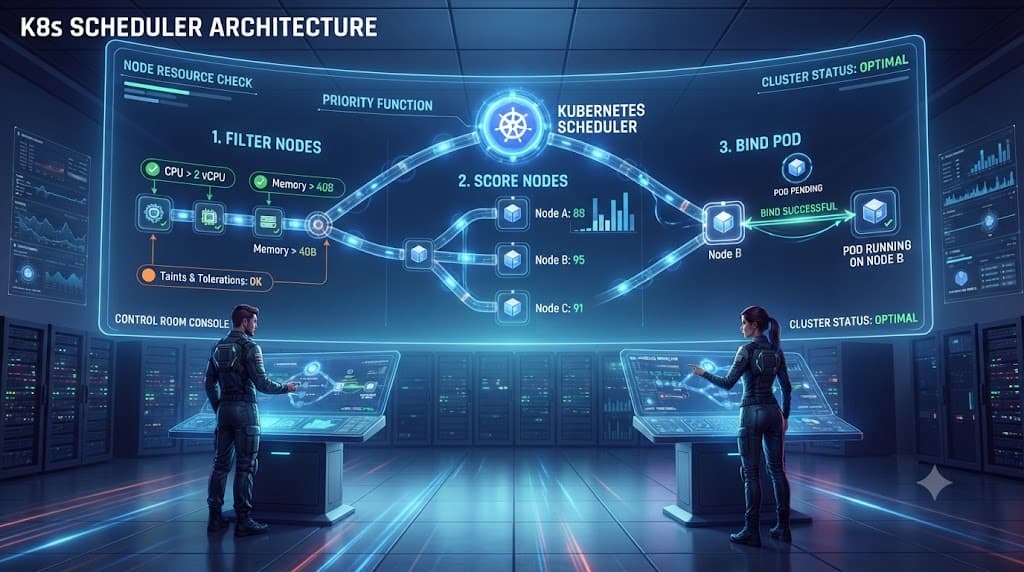
The scheduler core now features enhanced queue sorting algorithms that prioritize pods based on workload priority classes and topological constraints concurrently. This prevents smaller, high-priority interactive pods from indefinitely blocking massive multi-node batch allocations. Furthermore, improved scheduling plugins allow administrators to define custom scoring functions that weigh network proximity, GPU interconnect topology, and local storage latency against overall cluster load.
To visualize how these architectural layers interact during a high-throughput scheduling cycle, consider the pipeline above. Each phase has been optimized in v1.37 to reduce lock contention on the API server, ensuring that rapid cluster autoscaling events do not overwhelm the control plane.
Practical Implications for AI/ML and Batch Workloads
For platform engineers and DevOps practitioners operating large-scale AI/ML infrastructure, the features in Kubernetes v1.37 translate directly into tangible operational efficiencies. When training large language models or executing complex data engineering pipelines, waiting for scattered node resources can waste thousands of compute hours. Enhanced batch scheduling capabilities ensure that jobs either acquire all required resources atomically or yield gracefully, preventing partial allocations that lock up cluster capacity.
| Feature Capability | Previous Behavior (v1.36 and earlier) | Kubernetes v1.37 Improvement |
|---|---|---|
| Gang Scheduling | Relied on external custom batch hooks | Native queue-level affinity coordination |
| Topology Scoring | Basic pod anti-affinity rules | Dynamic GPU interconnect matrix scoring |
| Queue Throttling | Potential API server lock contention | Optimized lock-free evaluation queues |
Platform teams can configure these features by defining updated scheduling profiles within their scheduler configuration manifests. By tuning the extension points for pre-filter and reserve phases, administrators can tailor cluster behavior precisely to match the demands of both latency-sensitive web services and throughput-heavy batch jobs.
[!TIP] Pro Tip: When upgrading to Kubernetes v1.37, review your existing custom scheduler plugins. Many legacy out-of-tree batch coordination mechanisms can now be migrated to native scheduler profiles to reduce long-term maintenance overhead.