Quick Answer
Kubernetes has long provided various mechanisms to inspect and describe the state of compute nodes in a cluster. Traditional signals like Node Readiness, custom taints, Pod status transitions, and provider-specific cloud controller integrations each offer a fragmented picture of actual infrastructure health. When infrastructure degrades or hangs, cluster administrators have historically relied on a patchwork of external controllers, bespoke scripts, and ad-hoc annotations to interpret true node availability. This fragmentation introduces cognitive overhead, delayed remediation, and inconsistent behavior across multi-cloud and hybrid environments, setting the stage for a more unified approach in Kubernetes v1.37.
Introduction to Node Health Fragmentation in Kubernetes
Managing node health at scale has always required balancing multiple independent control loops. Node Readiness checks via the kubelet evaluate local daemon health, container runtime responsiveness, and basic filesystem metrics. However, Readiness alone cannot distinguish between a transient network partition, an underlying kernel panic, or an impending hardware failure. Consequently, platform engineers often deploy custom node health controllers to inject taints or manipulate labels when anomalies occur. This patchwork of signals creates blind spots. A node might report Ready while its underlying storage fabric is completely unresponsive, leading to cascading pod failures and difficult-to-debug scheduling anomalies. Kubernetes v1.37 directly targets this historical fragmentation by introducing a standardized, native framework for node health signaling.
How Node Lifecycle Conditions Work in Kubernetes v1.37
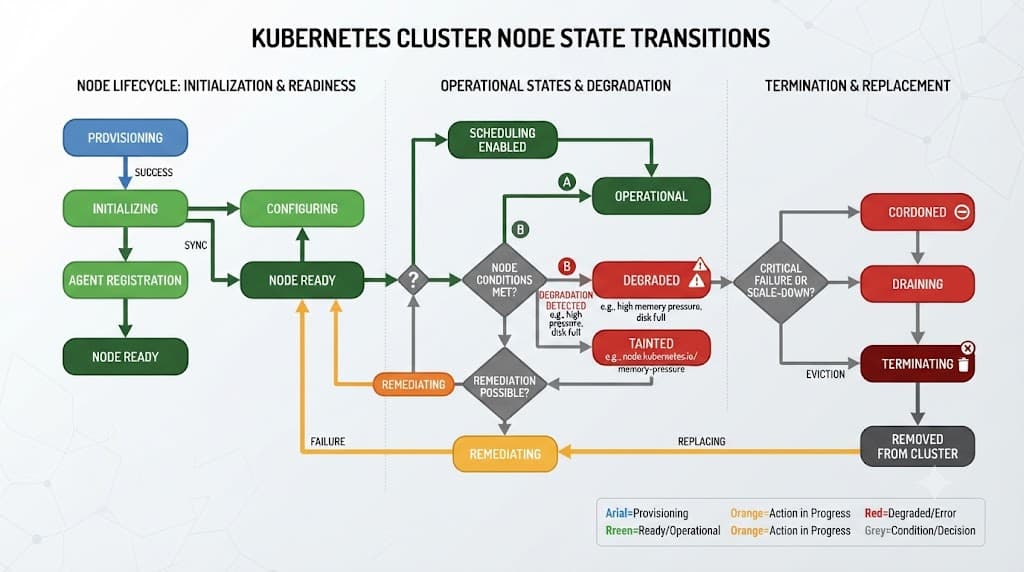
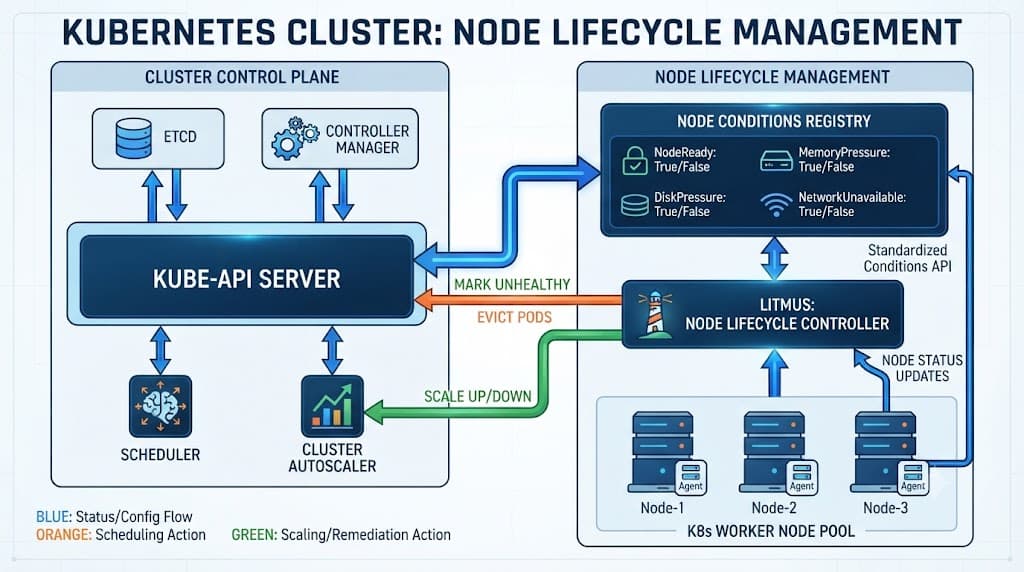
Kubernetes v1.37 introduces a shared, Kubernetes-owned way to express exact node health states through dedicated Node Lifecycle Conditions. Instead of forcing control planes and third-party tools to invent custom taints and transient annotations, the core API now natively exposes granular lifecycle states that describe whether a node is booting, operational, degrading, or terminating.
By decoupling the concept of node readiness from overall lifecycle state, the control plane can communicate nuanced operational phases to schedulers, autoscalers, and external operators. For instance, a node experiencing severe memory pressure or unrecoverable hardware corruption transitions through clearly defined lifecycle conditions. This enables the kube-scheduler and deschedulers to make intelligent workload eviction decisions without relying on delayed heartbeats or guessing the intent behind arbitrary taints.
[!NOTE] Architectural Note: Node Lifecycle Conditions do not replace traditional Node Readiness overnight. Instead, they run concurrently, feeding rich telemetry into the core control plane to improve decision-making accuracy.
Operational Benefits and Migration Strategies
Adopting the new node lifecycle framework in Kubernetes v1.37 offers substantial operational advantages for DevOps teams managing large-scale infrastructure. By standardizing how node health is communicated, cluster operators can drastically reduce the complexity of custom alerting pipelines and automated remediation scripts.
✓ Advantages
- Unified native signaling removes reliance on fragile custom annotations
- Faster detection of infrastructure degradation before complete node failure
- Smoother integration with cluster autoscalers and third-party remediation operators
- Reduced false positives during transient network partitions
✕ Considerations
- Legacy custom controllers may need refactoring to consume native conditions
- Monitoring dashboards require updates to track new lifecycle phases
- Team workflows must adapt to the new vocabulary of node states
When planning a migration to clusters running v1.37, platform engineers should audit existing custom node health controllers. Ensure that monitoring stacks and alerting rules are updated to recognize the native lifecycle states rather than relying solely on deprecated condition types or bespoke taints. Gradual rollout across non-production environments remains the safest path to validate how existing workloads respond to refined eviction triggers.