Quick Answer
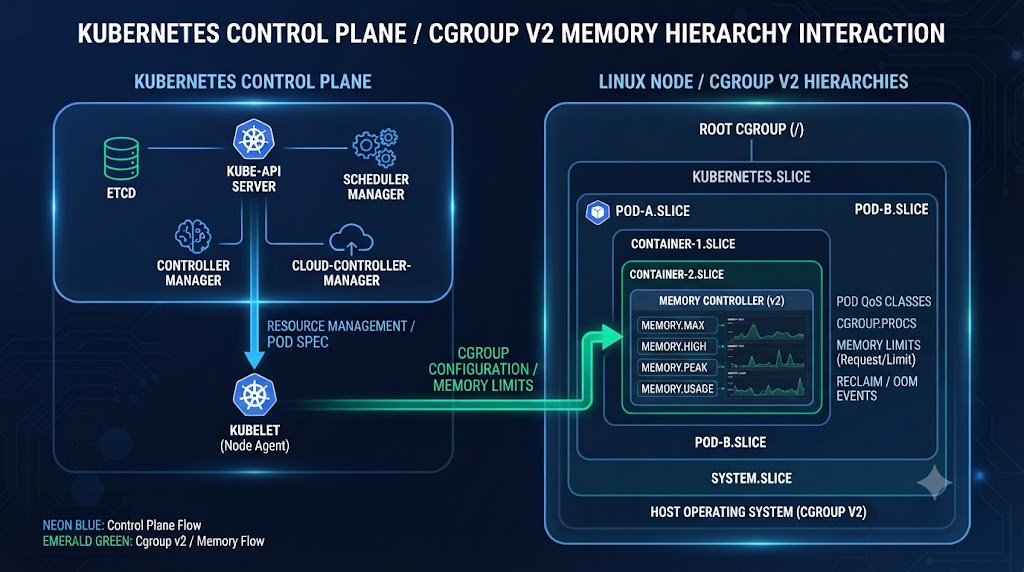
The release of Kubernetes v1.37 introduces a significant enhancement for cluster administrators and DevOps engineers managing Linux workloads: Memory QoS has officially graduated to Beta and is now enabled by default. For years, managing container memory limits and preventing noisy neighbors or sudden Out-Of-Memory (OOM) kills has been a delicate balancing act. With the widespread adoption of modern Linux kernel features, Kubernetes can now leverage deeper OS-level primitives to handle container memory more gracefully.
Introduction to Memory QoS in Kubernetes v1.37
Kubernetes v1.37 brings a wave of maturity updates, but few features carry as much operational weight for stability as the promotion of Memory Quality of Service (QoS). Previously, managing memory allocation relied heavily on static limits that could easily trigger abrupt container terminations when memory pressure spiked. By moving to Beta and enabling this capability by default, Kubernetes actively harnesses the underlying kernel mechanics to ensure critical workloads receive predictable access to memory resources.
[!NOTE] Architecture Note: Memory QoS does not replace resource requests and limits; instead, it provides a smarter translation layer from Kubernetes pod specifications down to the Linux kernel.
When running clusters on modern Linux distributions, resource management requires alignment between container orchestration tools and the host operating system. The graduation of this feature means that administrators no longer need to manually toggle complex configuration flags to benefit from improved memory throttling behaviors. Instead, the control plane and kubelet work in tandem to establish robust memory protection boundaries out of the box.
How Memory QoS Works with cgroup v2
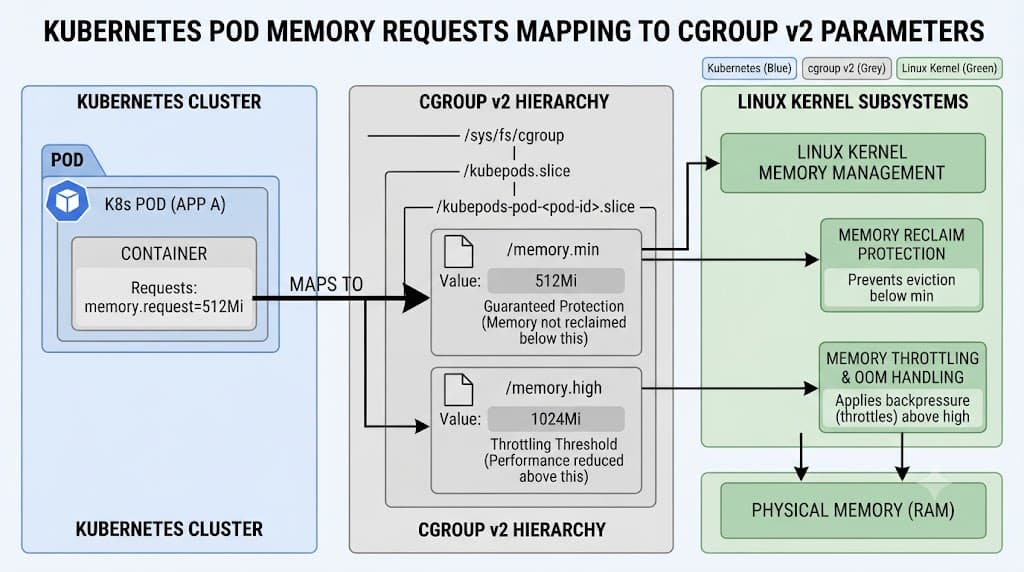
The technical foundation of Memory QoS relies entirely on cgroup v2, the modern Linux control group interface. Unlike its predecessor cgroup v1, which handled resource controllers independently and often suffered from synchronization issues, cgroup v2 provides a unified hierarchy. This unified design allows the Linux kernel memory controller to exercise much finer control over pressure, reclamation, and allocation.
Under the hood, the feature maps Kubernetes container memory requests and limits directly to cgroup v2 parameters such as memory.min and memory.high. The memory.min parameter acts as a hard protection floor—memory allocated within a pod's request is shielded from reclamation as long as the workload stays within that boundary. Meanwhile, memory.high acts as an early throttling threshold, slowing down memory-hungry processes before they exhaust node resources and force an aggressive OOM killer invocation.
[!TIP] Pro Tip: Ensure your nodes are actively running a modern Linux kernel with cgroup v2 fully enabled to take full advantage of these default behaviors.
Impact and Operational Benefits for DevOps Teams
For DevOps teams and platform engineers, the default enablement of Memory QoS in Kubernetes v1.37 translates to significantly fewer unexpected application crashes due to erratic memory spikes. Workloads that experience temporary bursts can be throttled smoothly by the kernel rather than instantly terminated, providing applications a chance to shed load or recover gracefully.
✓ Advantages
- Predictable memory allocation for critical services
- Reduced incidence of unexpected OOM kills
- Native integration with cgroup v2 mechanics
✕ Considerations
- Requires cgroup v2 compatible Linux kernel
- Legacy systems require manual kernel upgrades
- Monitoring tools must account for throttling metrics
Administrators should review existing monitoring dashboards to observe changes in container throttling metrics. Because the kernel now actively manages memory pressure via memory.high, you may notice subtle changes in application latency profiles during high-load scenarios. Adjusting your resource requests and limits in accordance with these new kernel-level guarantees will ensure optimal performance across your production fleets.