Quick Answer
Kubernetes cluster security takes a monumental leap forward with the release of Kubernetes v1.37, which officially promotes the KubeletInUserNamespace feature gate to beta status. Historically, operating a Kubernetes node required the primary control loops and runtime helpers—most notably the kubelet, container runtimes, and networking layers—to execute with full administrative root privileges on the underlying host operating system. While container isolation protected host workloads from one another, a compromise of the kubelet or associated node components could potentially cascade into full host takeover. By leveraging Linux user namespaces, Kubernetes v1.37 enables true rootless node operations, drastically shrinking the attack surface of cloud-native infrastructure.
Understanding KubeletInUserNamespace in Kubernetes v1.37
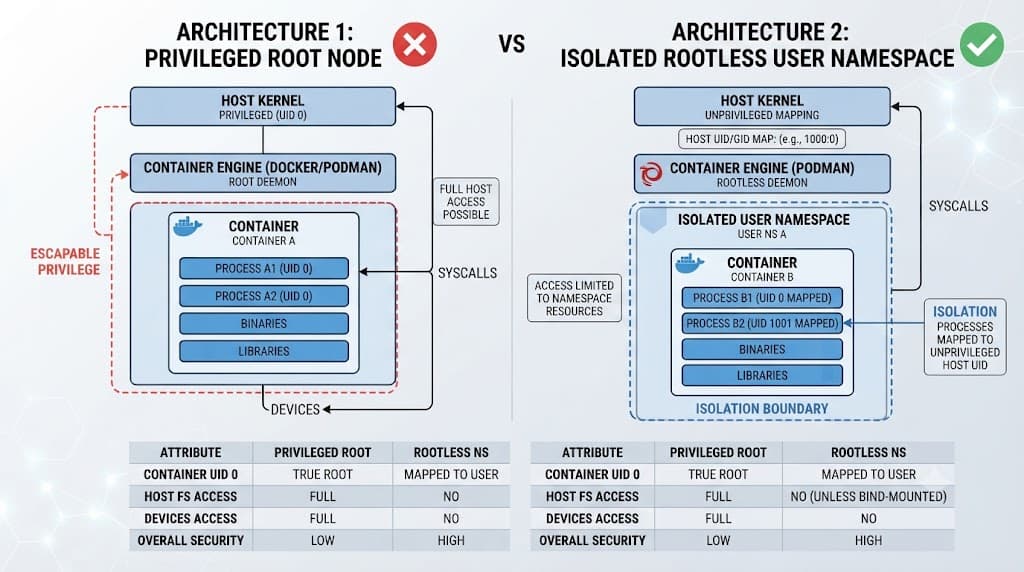
The KubeletInUserNamespace feature gate fundamentally changes how the kubelet interacts with the host kernel. At its core, a Linux user namespace maps a range of user IDs (UIDs) and group IDs (GIDs) inside an isolated environment to a completely different set of IDs on the host. When this feature is activated, the kubelet and its companion daemons run inside a dedicated user namespace. To processes running within this namespace, the kubelet process appears to run as UID 0 (root), granting it the internal permissions necessary to manage container networking, storage volumes, and process lifecycles. However, to the host kernel, that exact same process maps to an unprivileged user account, such as a dedicated service user.
This architectural decoupling means that even if an attacker manages to break out of a container and compromise the node-level runtime layers, they are trapped within the constraints of an unprivileged user mapping on the host. They cannot modify system-wide kernel parameters, manipulate critical host directories directly, or escalate privileges to compromise adjacent virtual machines or bare-metal hypervisors.
[!NOTE] Architectural Background: Linux user namespaces have existed in the kernel for years, but coordinating their use across complex interdependent daemons like the kubelet, low-level container runtimes, and networking plugins required years of careful upstream refactoring.
Architecture and Components of Rootless Kubernetes Nodes
Achieving a completely rootless node state requires synchronized orchestration across every layer of the container stack. In standard Kubernetes deployments, running isolated containers was only half the battle because the management plane on the node remained privileged. With Kubernetes v1.37, the entire suite of node components can transition smoothly into rootless operation.
✓ Rootless Stack Benefits
- Zero host root requirement for node daemons
- Isolated UID/GID mapping prevents privilege escalation
- Drastically reduced blast radius during container breakouts
- Seamless compatibility with existing container workloads
✕ Operational Complexities
- Strict dependency on modern Linux kernel versions
- Requires careful mapping configuration for persistent storage
- CNI plugin compatibility must be explicitly verified
- Debugging node-level issues requires user-namespace awareness
The transition impacts several critical subsystems:
- Kubelet: The primary node agent manages local pods, mounting volumes, and health reporting while residing inside the unprivileged namespace boundary.
- Container Runtimes (CRI/OCI): Tools such as containerd or CRI-O execute container processes using shifted UIDs, ensuring that container root maps safely to non-root host accounts.
- CNI Plugins: Networking plugins configure pod interfaces, bridges, and IP masquerading without needing unrestricted network administrative capabilities on the host root namespace.
- Kube-Proxy: Network routing and iptables/nftables manipulation are handled through user-namespace-compatible abstractions or specialized proxy modes.
Security Implications and Deployment Considerations
Deploying rootless Kubernetes nodes with KubeletInUserNamespace in v1.37 introduces powerful security hardening capabilities, but it also demands rigorous planning by platform engineers. Because user namespaces alter how file ownership and permissions are interpreted, storage volumes and persistent volume claims must support ID-mapping or be provisioned with compatible permissions to prevent permission-denied errors upon container startup.
[!WARNING]
Security Warning: Ensure your underlying Linux distribution runs a modern kernel (ideally Linux 6.0+) with robust user namespace support and sufficient user/group allocation limits configured in /etc/subuid and /etc/subgid.
Cluster operators should approach adoption incrementally. Begin by testing non-production worker pools with the feature gate enabled, validating that monitoring agents, log collectors, and storage drivers operate as expected. As organizations strive for zero-trust architectures, rootless Kubernetes nodes represent an essential milestone in neutralizing container escape vulnerabilities.