Quick Answer
The evolution of generative artificial intelligence has been largely defined by a recurring constraint: latency. Traditional large language models operate on a request-response paradigm characterized by batch inference, text tokenization delays, and pipeline fragmentation. When building conversational agents or real-time multimodal assistants, developers have historically been forced to chain separate models—transcribing speech to text via Whisper, processing text through a GPT checkpoint, and synthesizing audio via Text-to-Speech engines. This cascaded approach introduces compounding latency penalties, often pushing total response times beyond two seconds, shattering the illusion of natural, human-like interaction. The gpt astra openai initiative represents a foundational architectural pivot away from cascaded pipelines toward native, end-to-end multimodal streaming.
By unifying audio, visual, and textual tokens into a single cohesive embedding space, this architecture strips away intermediate text conversion layers. For systems architects and machine learning engineers, understanding how the underlying model achieves sub-300 millisecond response times requires examining the low-level tensor execution pathways, memory bandwidth optimizations, and distributed network handling that make continuous stream processing viable at planetary scale.
Introduction to OpenAI Astra and the Latency Imperative
For more detail, see developer-first architectural breakdown.
To appreciate the engineering breakthroughs embodied in the gpt astra openai initiative, one must dissect the mathematical and mechanical sources of latency in traditional transformer architectures. In a standard LLM serving framework, inference is compute-bound during the prompt processing (prefill) phase and memory-bandwidth-bound during the token generation (decode) phase. When multimodality is bolted on via external encoders, each modality introduces its own serialization overhead, context window inflation, and queueing delays.
[!NOTE] Architectural Note: Traditional cascaded pipelines force audio waveforms to undergo discrete Fourier transforms, framing, encoding, and textual translation before the core LLM ever sees a token. Each step introduces frame-level buffering latency.
OpenAI Astra fundamentally re-architects this flow by treating audio frames and video streams as first-class token citizens. Instead of converting speech to text, the system ingests raw audio spectrograms or compressed temporal patches directly into the transformer backbone. This eliminates the translation bottleneck entirely. The latency imperative is clear: human conversational dynamics break down when response latency exceeds 400 milliseconds. Achieving conversational fluidity demands an end-to-end pipeline capable of asynchronous stream ingestion and parallelized token generation.
Core System Definition and Model Topology
The fundamental openai astra model structure departs significantly from standard decoder-only transformer topologies by implementing a unified multimodal cross-attention mechanism. In classical multimodal models, a vision encoder or audio encoder produces feature maps that are projected into the LLM embedding space via linear layers or Q-Former networks. While effective for image captioning or offline analysis, these projection layers act as sequential bottlenecks that prevent real-time bidirectional streaming.
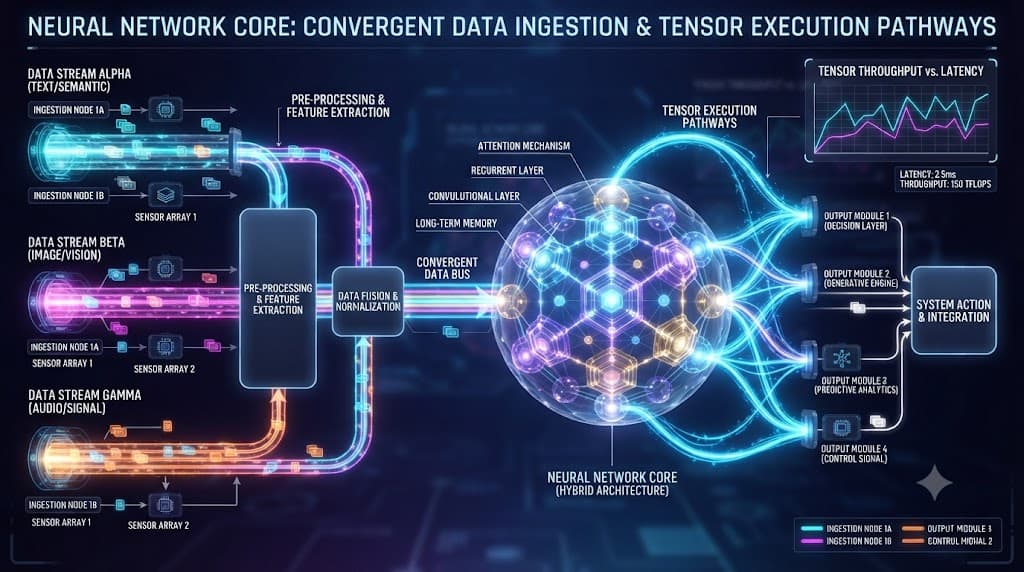
The topology utilizes a shared backbone where modality-specific tokenizers map continuous sensory inputs into a shared latent vector space. The model relies on interleaved temporal attention layers that can process visual frame patches alongside audio tokens and text embeddings within the same context window. This unified approach allows the model to capture prosody, emotional inflection, and visual cues simultaneously without losing temporal synchronization.
Under the Hood: gpt astra architecture and Tensor Execution
For more detail, see GPT-6 Astra's architecture, API mechanics, and deployment realities.
Examining the gpt astra architecture reveals deep hardware-software co-design choices optimized for extreme memory bandwidth utilization. During real-time streaming inference, the KV-cache (Key-Value cache) grows continuously with every incoming audio frame and visual patch. On commodity GPU clusters, the memory bandwidth required to fetch KV-cache tensors for long-context multimodal streams quickly saturates High Bandwidth Memory (HBM3e) interfaces, leading to severe execution stalls.
To mitigate this, the architecture employs aggressive paged attention variants combined with hardware-level quantization techniques that dynamically adjust precision based on token saliency. Audio and video tokens, which exhibit high temporal redundancy, utilize lower precision storage formats in deeper attention layers, while critical reasoning tokens retain higher precision. Furthermore, kernel fusion is heavily utilized to combine layer normalization, attention projections, and activation functions into single GPU kernel invocations, minimizing round-trip memory access latency between SRAM and global HBM.
Engineering How It Works: Real-Time Stream Handling
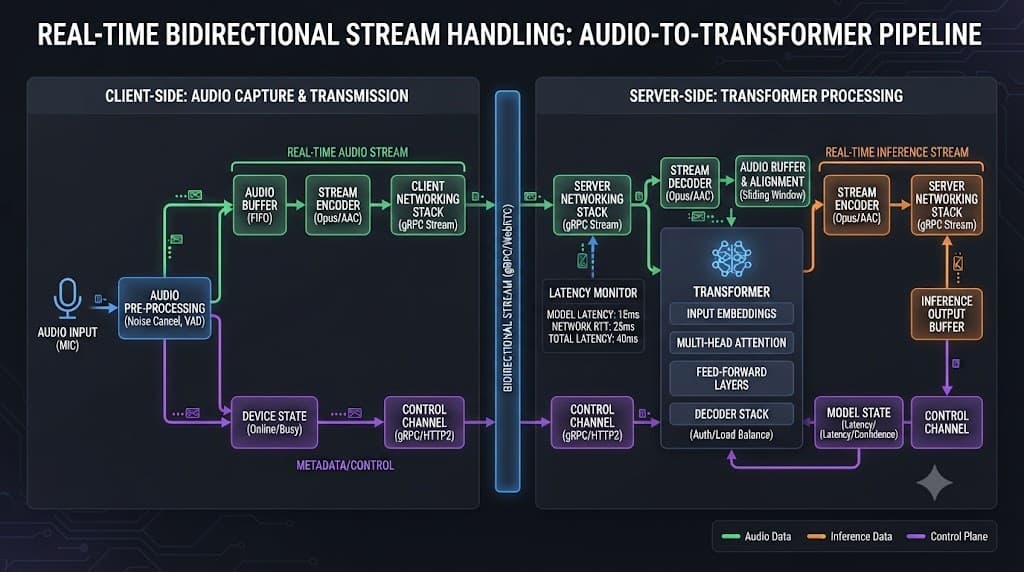
The mechanics of how astra ai capabilities handle continuous streaming inputs involve sophisticated packet-level buffering and asynchronous queue management. In a live voice or video session, network jitter and variable packet arrival rates pose a constant threat to inference stability. If an audio packet is delayed over a WebSocket connection, a naive inference engine will stall or hallucinate filler tokens.
The streaming runtime solves this by implementing predictive jitter buffers and token-level speculative execution. While the client streams continuous sensory data, the server-side runtime maintains a sliding inference window. If network jitter spikes, the model can predict short-term acoustic continuations locally before confirming weights against incoming packets. This bidirectional streaming protocol operates over optimized transport layers, bypassing standard HTTP/1.1 overhead in favor of multiplexed binary framing protocols.
Performance Benchmarks and Real-World Latency Constraints
Evaluating the openai next gen astra rollout requires rigorous measurement of time-to-first-token (TTFT) and time-to-first-audio-byte (TTFAB). In controlled benchmarking environments, traditional multimodal pipelines average 1,200ms to 2,000ms before emitting an audible response. In contrast, the unified streaming architecture achieves sub-300ms TTFAB under optimal network conditions.
However, real-world deployments face severe physical constraints. Network packet loss, client-side encoder latency, and geographic distance from inference edge nodes introduce variable overhead. Furthermore, sustained high-throughput video streaming places intense thermal and power demands on datacenter accelerators, requiring advanced liquid cooling and cluster-level load balancing to prevent throttling during peak global demand.
Concrete Developer Implementation Example
Interfacing with low-latency streaming endpoints requires an asynchronous programming model capable of handling bidirectional backpressure. Below is a conceptual architecture pattern demonstrating how developers establish and manage a real-time streaming session using asynchronous WebSockets.
import asyncio
import websockets
import json

async def stream_multimodal_session(endpoint_url, api_key):
    headers = {
        "Authorization": f"Bearer {api_key}",
        "OpenAI-Beta": "realtime=v1"
    }

    async with websockets.connect(endpoint_url, extra_headers=headers) as websocket:
        # Initialize session configuration
        init_event = {
            "type": "session.update",
            "session": {
                "modalities": ["text", "audio"],
                "voice": "alloy"
            }
        }
        await websocket.send(json.dumps(init_event))

        # Concurrently handle outgoing media stream and incoming response stream
        async def send_audio_frames():
            while True:
                # Mock capturing raw PCM audio chunk
                pcm_chunk = await get_audio_input_buffer()
                audio_event = {
                    "type": "input_audio_buffer.append",
                    "audio": pcm_chunk
                }
                await websocket.send(json.dumps(audio_event))
                await asyncio.sleep(0.02) # 20ms frame intervals

        async def receive_responses():
            async for message in websocket:
                event = json.loads(message)
                if event["type"] == "response.audio.delta":
                    play_audio_output(event["delta"])

        await asyncio.gather(send_audio_frames(), receive_responses())

async def get_audio_input_buffer():
    # Placeholder for hardware audio capture interface
    return "base64_encoded_pcm_bytes"

def play_audio_output(chunk):
    # Placeholder for audio hardware playback buffer
    pass
[!TIP] Pro Tip: Always implement client-side audio resampling to match the exact sample rate (e.g., 24kHz PCM) expected by the server endpoint to avoid runtime resampling overhead and buffer underruns.
System Limitations, Trade-offs, and Roadmap Realities
Despite significant engineering advancements, several architectural bottlenecks and trade-offs remain. The computational density required to run unified multimodal attention mechanisms at scale results in high serving costs compared to traditional text-only models. Additionally, context window management across mixed modalities introduces memory fragmentation challenges during extended multi-turn conversations.
✓ Advantages
- Sub-300ms end-to-end response latency
- Native audio and video token processing
- Elimination of cascaded translation pipelines
- Fluid conversational turn-taking and interruption handling
✕ Limitations
- High GPU memory bandwidth and cluster power consumption
- Complex state management for bidirectional streaming backpressure
- Substantial serving cost overhead relative to text-only models
- Strict client-side network jitter sensitivity
Regarding the openai astra release date timeline, engineering teams maintain iterative deployment strategies rather than monolithic launch dates. Gradual API rollouts and developer preview tiers allow infrastructure scaling to match the immense bandwidth requirements of continuous global audio-visual streaming without destabilizing core production workloads.