Quick Answer
Linux is the invisible backbone of modern digital infrastructure. Whether you are browsing a website, running a containerized application, or managing cloud-based server clusters, chances are high that Linux is powering the underlying host environment. Understanding what is linux, how its architecture operates, and how to navigate its command line is a fundamental requirement for any software developer, systems engineer, or DevOps practitioner. Rather than treating the operating system as a black box, mastering its core mechanics allows you to write more efficient software, configure secure containers, and troubleshoot production issues with confidence.
Quick Answer: What Is Linux?
At its core, what is linux refers to a free, open-source, Unix-like operating system kernel originally created by Linus Torvalds in 1991. The term "Linux" strictly describes the kernel—the low-level software that bridges computer hardware and system software. However, in everyday conversation and professional engineering, "Linux" refers to a complete operating system distribution (often called a distro) that combines the Linux kernel with GNU utilities, system libraries, compilers, window managers, and package management systems. Unlike proprietary operating systems, Linux gives users complete transparency and control over source code. Its modular design, stability, security model, and performance make it the dominant platform for cloud computing, enterprise servers, embedded systems, and containerized workloads.
Understanding What Is Linux and Its Core Architecture
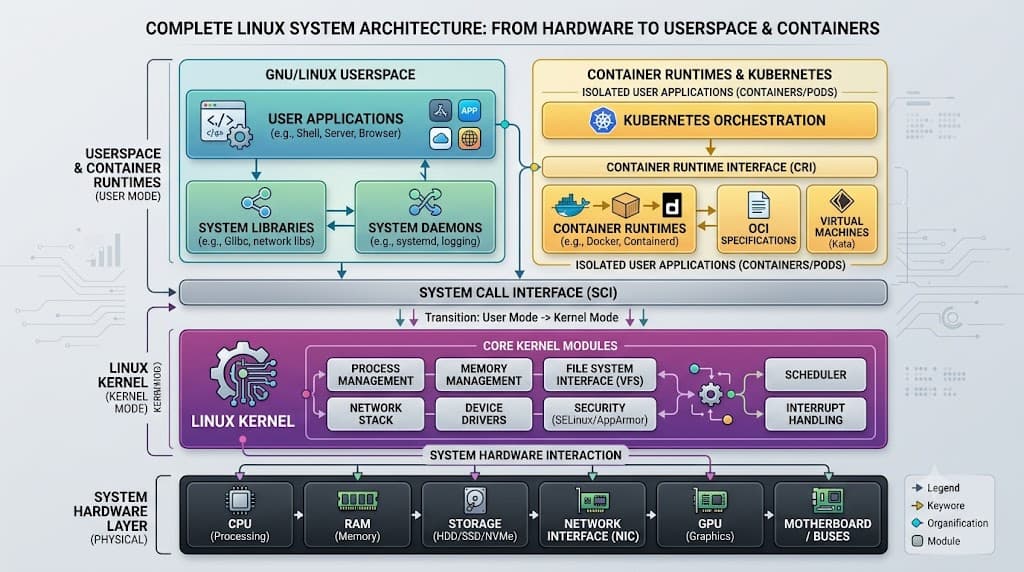
To truly grasp what is linux, you must look beneath the surface and examine its internal architecture. At the lowest level, hardware interacts directly with the Linux kernel. The kernel manages system memory, schedules CPU processes, coordinates hardware drivers, and enforces security boundaries. Above the kernel sits the system user space, which houses the utilities, daemons, libraries, and applications that users and administrators interact with.
Unlike monolithic operating systems, the Linux architecture is modular. Device drivers, filesystems, and network protocols can be loaded and unloaded as kernel modules without requiring a full system reboot. This flexibility allows developers to strip down installations for minimal container images or scale them up for high-performance computing clusters. Every running application or utility on a Linux system is represented as a process, uniquely identified by a Process ID (PID). The system init process—traditionally SysVinit, but modern distributions universally use systemd—manages system startup, service dependencies, and background daemons.
The filesystem is another critical pillar of the Linux operating system. In Linux, everything is treated as a file, including directories, hardware devices, sockets, and processes. The directory structure is organized as a single hierarchical tree starting at the root directory (/). Directories such as /bin, /etc, /var, /home, and /usr each serve a specific purpose, adhering to the Filesystem Hierarchy Standard (FHS). Understanding this layout is essential for locating configuration files, log data, and application binaries during development and debugging.
Essential Linux Command Line Concepts for Developers
While graphical user interfaces exist, professional developers and DevOps engineers primarily interact with Linux via the command line interface (CLI). The terminal emulator provides a text-based window into the shell—the command interpreter that executes user commands. Common shells include Bash (Bourne Again SHell) and Zsh. When you open a terminal, you are interacting with a shell session that parses your inputs, interacts with the kernel, and returns output.
Understanding command-line fundamentals requires grasping three core concepts: standard streams, permissions, and environment variables. Linux utilizes three primary data streams: Standard Input (stdin, file descriptor 0), Standard Output (stdout, file descriptor 1), and Standard Error (stderr, file descriptor 2). Developers frequently redirect these streams using operators like >, >>, and | (pipe) to chain commands together, filter log files, or automate data processing.
Permissions dictate security and access control across the filesystem. Every file and directory is assigned an owner, a group, and a set of permission bits governing Read (r), Write (w), and Execute (x) rights. In production environments, mastering user management and permission flags prevents unauthorized modifications and privilege escalation vulnerabilities.
Practical Commands, Examples, and Verification
To move from theory to practice, you must be comfortable executing real terminal commands, understanding their expected behavior, and verifying their results. Below are several foundational commands commonly used in software development and server administration.
Checking System and Kernel Information
To verify the specific version of the Linux operating system running on your host, you can inspect system release files or query the kernel directly.
uname -r
cat /etc/os-release
Expected Behavior: The uname -r command outputs the exact version string of the active kernel. The cat /etc/os-release command displays distribution-specific identification data, such as Ubuntu, Debian, or Red Hat Enterprise Linux release details.
Verification: Compare the output against your expected deployment baseline to ensure package compatibility and security patch levels.
Inspecting Running Processes and Resource Consumption
Developers often need to check whether a specific application server, database, or background worker is running.
ps aux | grep nginx
pgrep -l python
Expected Behavior: The ps aux command lists all active system processes, which is then filtered via the pipe (|) and grep utility to display only processes matching "nginx". Alternatively, pgrep -l python lists process IDs and names for running Python interpreters.
Verification: Verify that the listed Process IDs match expected runtime states and consume reasonable memory and CPU resources.
Managing File Permissions and Ownership
Incorrect permissions frequently break web servers, deployment scripts, and CI/CD pipelines.
chmod 755 deploy.sh
chown www-data:www-data /var/www/html
Expected Behavior: The chmod 755 command grants read, write, and execute permissions to the file owner, while restricting group and other users to read and execute access. The chown command updates the user and group ownership of the target directory.
Verification: Run ls -l deploy.sh to confirm that the permission string displays -rwxr-xr-x and that ownership reflects the intended user and group.
Connecting Linux to Modern DevOps Workflows
Linux is not an isolated desktop environment; it is the absolute foundation of modern containerization, orchestration, and continuous integration pipelines. Understanding what is linux enables developers to build better cloud-native applications.
Take Docker, for example. Docker containers do not run a full operating system; instead, they share the host Linux kernel while isolating the userspace using Linux kernel namespaces and control groups (cgroups). When you write a Dockerfile starting with FROM ubuntu:latest or FROM alpine:linux, you are packaging your application binaries alongside a minimal Linux distribution root filesystem. Knowing how file permissions work inside Linux is vital for preventing container processes from running with root privileges, a major security anti-pattern.
Similarly, Kubernetes orchestration platforms schedule container workloads across distributed pools of worker nodes running Linux. Understanding systemd service management, network routing tables, DNS resolution (/etc/resolv.conf), and log aggregation (journalctl) is mandatory when debugging why a Kubernetes pod cannot resolve an external service or why a container is crashing due to out-of-memory (OOM) limits.
In CI/CD pipelines—such as GitHub Actions runners—jobs execute inside Linux virtual machines or containers. Writing efficient shell scripts for build steps, caching dependencies correctly in /root/.cache, and managing environment secrets securely require a solid command of Linux environment variables and file permissions.
Common Mistakes and Safe Troubleshooting
Even experienced engineers encounter hurdles when working within a Linux environment. Recognizing common pitfalls helps prevent downtime and data loss.
A frequent mistake is executing commands with elevated privileges unnecessarily. Running every script or installation command as the root user bypasses safety guardrails and exposes the system to catastrophic errors. Another common error is misinterpreting exit codes; in Linux, a command exiting with 0 indicates success, while any non-zero integer signals an error condition that scripts must handle.
When troubleshooting broken services or network connectivity issues, follow a systematic approach:
- Inspect service status and error logs using system utilities.
- Verify network ports and listening sockets.
- Check disk space and inode utilization.
systemctl status nginx
journalctl -u nginx -n 50 --no-pager
ss -tuln
df -h
Expected Behavior: systemctl reports whether a service is active or failed, while journalctl outputs the last 50 log entries for that specific service without truncation. The ss -tuln command lists all listening TCP and UDP ports, and df -h displays human-readable disk partition usage.
Verification: Look for explicit error messages in the log output (such as permission denied or port binding failures) and confirm that required ports are open and storage partitions are not at 100% capacity.
WARNING: Exercise extreme caution when executing destructive commands in production environments. Operations involving recursive file deletion (rm -rf), disk partitioning (fdisk), or raw device writing (dd) can instantly wipe critical data. Always verify target variables and backup configurations before running high-risk administrative commands.
Linux Best Practices for Production Environments
Maintaining stable, secure Linux deployments requires adhering to established industry best practices.
First, adhere strictly to the principle of least privilege. Never run application servers, databases, or web apps as the root user. Create dedicated system service accounts with minimal required permissions.
Second, automate system updates and security patch management. Regularly apply kernel and package updates using your distribution's package manager (such as apt or dnf) while testing changes in staging environments first.
Third, implement robust logging, monitoring, and auditing. Configure log rotation to prevent disk exhaustion, monitor CPU, memory, and disk I/O metrics continuously, and secure SSH access by disabling password authentication in favor of cryptographic SSH keys.
By combining a deep theoretical understanding of what is linux with disciplined operational practices, developers and DevOps engineers can build resilient, high-performance systems capable of scaling reliably in any cloud environment.
📌 Recommended Next Guides & References
  <li>
    <a href="/article/docker-and-kubernetes-how-they-work-together-2" class="text-primary hover:underline font-semibold flex items-center gap-2">
      <span>→</span> <span>Docker and Kubernetes: How They Work Together</span>
    </a>
  </li>

  <li>
    <a href="/article/kubernetes-ingress-explained" class="text-primary hover:underline font-semibold flex items-center gap-2">
      <span>→</span> <span>Kubernetes Ingress Explained: Routing, Controllers, and TLS</span>
    </a>
  </li>

  <li>
    <a href="/article/kubernetes-ingress-controller-explained" class="text-primary hover:underline font-semibold flex items-center gap-2">
      <span>→</span> <span>Kubernetes Ingress Controller Explained: Architecture, Routing, and Implementation</span>
    </a>
  </li>